
Category Archives: Blog

Jael vs. Charlotte Corday: History’s Heroines or Villainesses?

The Bible’s Jael and French Revolution’s Charlotte Corday committing murder has to gone down with some of the most controversial moves in history.  It’s hard to say if they did the right thing . To understand why they did what they did, we need to look at the overall picture.

Jael

"Jael" by Spillberg

“Jael” by Spillberg


Barak wanted Deborah to go with him and his troops to face Canaanite army led by Sisera. Deborah agreed and told him, “The Lord shall sell Sisera in the hand of a woman” (Judges 4:9).

When Jael saw Siseria approaching, she acted as a friendly hostess. She welcomed him in her tent, gave him milk and blanket, and made sure he’s not disturbed. Then she “took a hammer in her hand, and went softly unto him, and smote the nail into his temples, and fastened into the ground: for he was fast asleep and weary. So he died” (Judges 4:21).

Tissot_Jael_Smote_Sisera,_and_Slew_Him

“Jael Smote Sisera and Slew Him” by Tissot

"Jael Shows to Barak Sisera Lying Dead" by Tissot

“Jael Shows to Barak Sisera Lying Dead” by Tissot

She went out to meet Barak who was no doubt graetful. Thanks to Jael, Israel gained momentum in fighting Canaan.  “God subdued on that day Jabin king of Canaan before the children of Israel. And the hand of the children of Israel prospered, and prevailed against Jabin the king of Canaan, until they had destroyed Jabin king of Canaan” (Judges 4:23-24).

What a wonderful and victorious ending. She killed a key captain making way for Israel to eventually kill the king.

Deborah praised Jael: “Blessed above women shall Jael the wife of Heber the Kenite be, blessed shall she be above women in the tent” (Judges 5:2)

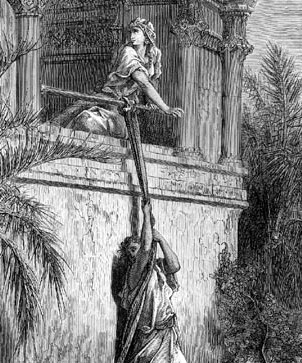
"Deborah Praises Jael" by Gustave Dores

“Deborah Praises Jael” by Gustave Dores


Charlotte Corday

Charlotte Corday

“Charlotte Corday” From Evert A. Duykinck’s “A Portrait Gallery of Eminent Men and Women of Europe and America, with Biographies.”


During the French Revolution, a twenty-four-year old gave herself a mission. She planned to kill Jean-Paul Marat.

Charlotte Corday lived in in Normandy. She sympathized with the Girondists, a political group moderates—who were not for an absolute monarchy but didn’t like where the revolution was going. She, like other Girondists, were disgusted with the politics of the Jacobins, members of a radical political club, who used terror and violence to wipe out their opponents in the Reign of Terror such as the nobles and Girondists. Jean-Paul Marat, propaganda journalist and one of the Jacobin leaders, played a big role in that and most notably in the mass killings in Paris in 1792 which became known as the September Massacres. That event and the threat of civil war motivated Charlotte to take action and take out such a threat.

Going for the Most Venerable Leader

Without telling her plans to anyone, Charlotte traveled from Normandy to Paris with the intent to kill Marat. As mentioned before, Marat was a leader of the Jacobins, but he wasn’t the head leader.  Maximillian de Robespierre led the Reign of Terror. It’s been argued if she had to kill someone, it should have been Robespierre. That would have been like going for a king which actually would have made her mission impossible. Like Jael, Charlotte was going to wipe out a captain-figure not a type of king.

You could say both Charlotte and Jael used unorthodox weapons that usually served for every day use. Jael used a hammer and stake, and Charlotte used a six-inch blade kitchen knife she bought when she got to Paris .

Charlotte planned to kill Marat in front of the National Convention.  Due to illnesses, he was unable to make public appearances. He had developed a skin disorder probably from hiding in sewers. Charlotte found out he was staying with his wife Simone.  The first two times Charlotte went to the apartment, Simone turned her away. Charlotte claimed to have a list of Girondists that were plotting an uprising. On her third attempt, Marat wanted to speak with her.

Charlotte Corday et Marat by Jules Aviat 1880

Charlotte Corday et Marat by Jules Aviat 1880

L'Assassinat de Marat by Jean-Joseph Weerts

L’Assassinat de Marat by Jean-Joseph Weerts

Marat’s skin condition was so serious he did his work from the bathtub. As he wrote down the names, he was unaware that he was in such a vulnerable state. Charlotte stabbed him in the chest. He yelled to Simonne, and then he died. This was followed by a huge uproar and the arrest of Charlotte Corday on July 13, 1793.

Triumph?

Charlotte didn’t meet the same triumph as Jael. When Charlotte was tried, she was asked why she killed Marat.  She said she did it to save thousands. This answer had reflected Robespierre’s reaction to executing Louis XVI. Four days after killing Marat, Charlotte’s head went on the scaffold.

Did Charlotte Corday fail in her mission? It’s hard to say. She didn’t get the immediate praise Jael got for killing, but she made an immediate impact. One witness at her execution named Pierre Notelet said, “Her beautiful face was so calm, that one would have said she was a statue. Behind her, young girls held each other’s hands as they danced. For eight days I was in love with Charlotte Corday.”

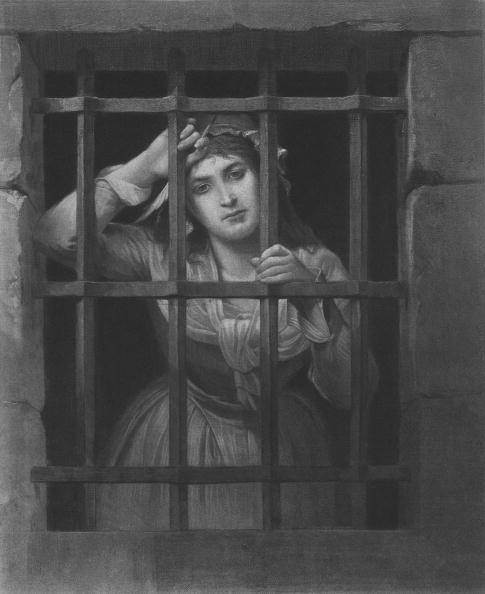
"Charlotte Corday" by Jean-Jacques Hauer. This portrait was done in prison at her request.

“Charlotte Corday” by Jean-Jacques Hauer. This portrait was done in prison at her request.

Adam Lux, another witness, was so impressed with Charlotte Corday, he published pamphlets that deemed Charlotte’s actions justified and for freedom. He was also executed. I believe this shows that people got thinking who the actual enemy of was. It wasn’t pro-monarchs or true republicans. Those in power during the Reign of Terror didn’t have the French citizens’ best interests in mind. They were dictators who used sources, like the press, to deceive and threaten the people. There were those like Charlotte Corday who called them out.  A year after Charlotte’s death, those who corrupted the government also had a date with Madame Guillotine, including Robespierre.

Charlotte Corday went on to influence others with her patriotic zeal. Writer Alphonse de Lamartine nicknamed her the “angel of assassination” in his 1847 book Histoire des Girondins.

In 1860, France was on the road to a republic that Charlotte had desired. The Jacques-Louis David’s 1793 painting portraying Marat as a martyr that the Jacobins used as propaganda was literally painted at a different angle. In Paul-Jacques-Aimé Baudr’s 1860 painting, Corday is portrayed as the heroine.

640px-Death_of_Marat_by_Jacques-Louis David

“Death of Marat” 1793by Jaques-Louis David. Here Marat is portrayed as martyr.


640px-Charlotte_Corday by Paul-Jacques-Aimé Baudry (2)

“Charlotte Codray” 1860 by Paul-Jaques-Aime Badry. Now, Charlotte is seen as the hero.


The Verdict

Did Jael do the right thing? Was Charlotte’s act justifiable?
I have studied the biblical text more and the Reign of Terror closer in order to come to a verdict. I’ve also considered the circumstances of war in their cases. I will not be a judge in the final judgement, but I’ve made my personal conclusions,
Jael: By killing the captain of the opposing army, Israel was able to win the battle and the war. She protected a nation by weakening the enemy. Verdict: Not guilty. Heroine.
Charlotte: Murdering a journalist responsible for massacres. It looked like she lost the battle, but her sacrifice was a necessary loss to win the war in finding freedom. She identified France’s true enemies. Verdict: Not guilty. Heroine.

Do you agree with my verdicts?  The situations are in gray areas. I see these two women acting for their great good their country. One lived to see victorious results, and the other died before she could witness the enemies’ downfalls.

Helpful information from
The Bible
wikipedia.com
alstewart.com 

 Images from
http://madameguillotine.org.uk
http://commons.wikimedia.org/

“Well-Behaved Women Seldom Make History”—What Does That Mean?

Laurel Ulrich was perplexed that she couldn’t find much information about Puritan women. As a graduate student at the University of New Hampshire, she was writing a seminar and then an article on early American women. She wanted to let people know that there were other women instead of just the witches. In her article, she wanted to stress that we need to pay attention to the invisible women and wrote “Well-behaved women seldom make history.”

A_fair_Puritan (3)

She wrote that in 1976. Nearly twenty years later, a journalist called her up and asked if she could use that quote. Ulrich said yes and soon got asked by others if they could to print that phrase on t-shirts. “Sure! Send me a t-shirt,” Ulrich replied. It was then that the phrase turned into a slogan and phenomenon. It’s been seen on bumper stickers, quilts, coffee mugs, and used by organizations. (Sometimes without her permission.) People interpreted it a variety of ways, and it was used quite differently than she intended. However, she took an interest in the different views of the phrase and saw why people used it the way they did.

So Ulrich decided to write a book called Well-Behaved Women Seldom Make History which explores why some women are remembered and why some are not, how they’re remembered, what has been done for them to be remembered, and what we can do. The book centers around three feminist writers—Christine de Pizan of France who lived in the fifteenth century, American Elizabeth Cady Stanton who lived in the nineteenth century, and Virginia Woolf of England who lived in the twentieth century. Though these three women lived in different time periods and places, they were concerned with the way women were viewed. Ulrich reflects on their lives while branching out to many other women who made a mark on history. I learned about women I hadn’t heard of and new information on subjects I already knew about it.

For example, I knew about Rosa Parks, but didn’t know there were other women before her who refused to give up their seat on the bus, but a journalist decided that she was the best candidate. Since she came from a conservative background, her actions would make a bigger impact.  Lots of times it’s the way people are presented that help them make history. Ulrich points out that it depends on what you mean by “well-behaved.”

Some daring women were almost not remembered—it took years and multiple efforts to publish an early biography of Harriet Tubman. How many other women need biographies? There are just so many women that are waiting for their stories to be told! At an authors’ conference discussing her book, Ulrich said “History is a dialogue between present and past….What we bring to it is our questions and our concerns. If some women are invisible in history it’s because for some reason that link between the present and past has been broken.”

It’s interesting to note that Ulrich doesn’t really discuss royalty—and that is actually quite refreshing! Ulrich uses a huge spectrum of women. From Joan of Arc being a controversial figure to Mormon polygamist wives who were career women and to the extreme 1970s to milkmaids’ contributions to society and back to us in modern times, your eyes will be opened and you will want to get out there and discover stories—including family stories. The importance of writing your own personal history also stands out.

Ulrich succeeded in writing as she put it a “feel good book.” (It’s already being used as a  future reference for this writer!) Her last chapter is powerful. It includes another woman, Jill Portugal, who owns a small t-shirt business. Her t-shirts say things like, “Ignore Celebrities” and “Anti-Porn Star.” Though she’s up against an industry that makes billions, her motto is brilliant: “Taking over the world one shirt at a time.”

Ulrich says, “If well-behaved women seldom make history, it is not only because gender norms have constrained the range of female activity but because history hasn’t been very good at capturing the lives of those whose contributions have been local and domestic.”

The last statement Ulrich makes has three valid points about how people can make history—the last being the most important. “Well-behaved women make history when they do the unexpected, when they create and preserve records, and when later generations care.”

823px-Unknown_maker,_French_-_Woman_Reading_to_a_Girl_-_Google_Art_Project


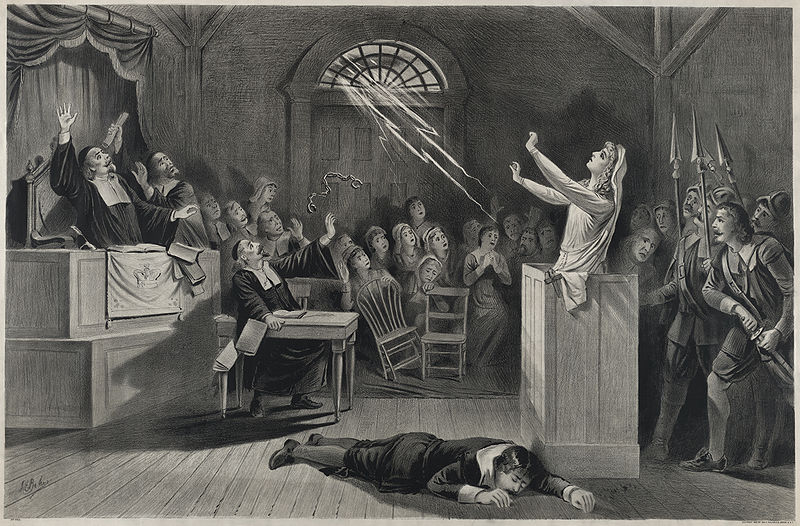
Pictures: Salem Witch by Joseph E. Baker, A Fair Puritan by E. Percy Moran,  and photograph of woman and child reading taken by unknown photographer

Marie Thérèse and Aunt Elisabeth

French Revolution. What comes to mind?

Madam Guillotine,  Marie Antoinette, and sink me–The Scarlet Pimpernel. The 1982 film adaption of the book made me laugh so hard. I was also in awe. Did such heroes exist?

There were those who smuggled nobles into other countries. The films shows that Marie Antoinette and Louis’s son survived and was taken from their prison to a safer place.

Wrong.

The sole survivor was the king and queen’s daughter, Marie Thérèse. who clung on to some hope that maybe her brother and mother who were taken away had survived.

I can’t believed I went on for years not knowing about her–or her aunt Elisabeth, the king’s sister. Elisabeth made sacrifice after sacrifice for the royal family–refusing to marry or take other available routes that would take her out of the country. She endured violent attacks with them and even posed as the queen to buy her sister-in-law more time during one ambush. It’s little wonder that Marie Antoinette and Louis counseled their children to listen to their aunt.

All too soon the royal family was taken to the Temple Tower. They endured unfair trials and living conditions grew worse. The king was executed and little Louis was taken to a separate cell. Marie Antoinette was taken away and also executed, but Elisabeth and Marie-Therese only knew the king’s fate. However, I believe Elisabeth knew her sister-in-law was dead and had a strong feeling her nephew was slowly dying. Marie Thérèse had the best chance of surviving.

The Heroic Aunt

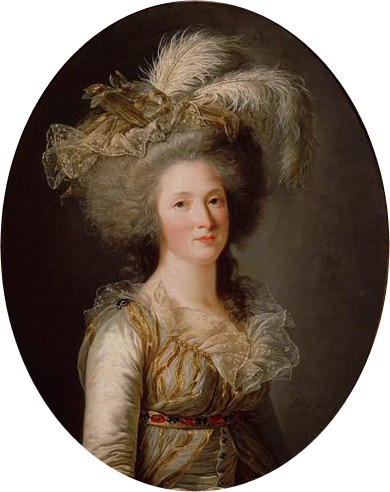
The heroic aunt. Elisabeth de France by Vigee-Lebrun.

 
When it was just Elisabeth and Marie Thérèse in the cell, Elisabeth comforted her niece. She was an example of piety, and Marie Thérèse said much of her survival was due to prayer. Elisabeth showed and advised her niece on how to groom herself, keep the cell as clean as possible, and how to handle the guards. It was just a matter of time before Elisabeth was taken away and was prepared to die a martyr. Marie Thérèse would not find out what happened to her aunt, mother, and brother till much later. The information that her aunt watched around twenty-five nobles executed before her and was purposely saved for last would be withheld.

Marie Thérèse was eventually freed and taken to Vienna in 1795 for safety.

The sole survivor. Portrait of Marie Thérèse of France by Heinrich Furger.

The sole survivor. Portrait of Marie Thérèse of France by Heinrich Furger.

Marie Thérèse would go on to help royal refugees and raise troops against Napoleon dubbed her the “only man in the family.” She worked hard to preserve the memory of her family. The following comment about her aunt Elisabeth needs to be remembered.

“I feel I have her nature . . . [she] considered me and cared for me as her daughter, and I, I honored her as a second mother.”

I hope I have some of Princess Elisabeth in me. Her story sticks out to me. In times of tough decisions, I have thought of my role as an aunt. Princess Elisabeth is a wonderful role model.  Her story is inspiring because it can make us think of ways we can be more loving toward our families.

Poet Profile: Rachel Bluwstein

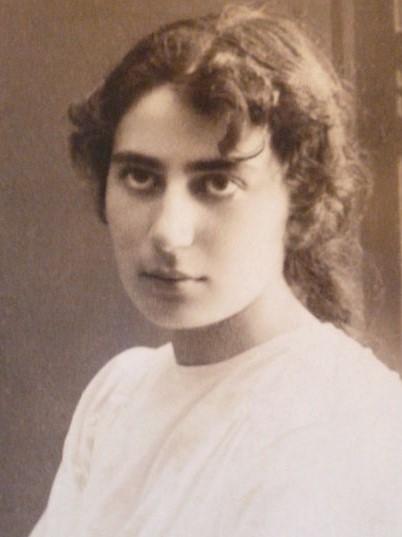
Rachel Bluwstein was born on September 20, 1890 in Russia. She lived in Ukraine, Palestine, France, and Israel. She was a Zionist pioneer and a Renaissance woman of sorts. She drew, painted, worked in agriculture, taught school, and is remembered for her lyrical, yet right-to-the-point poetry.

With with friend, Avraham Cahanowitz

With friend, Avraham Cahanowitz

For thousands of years, Hebrew poetry was dominated by males. The last known Hebrew woman poet was Deborah, a judge in ancient Israel.  Due to illness, Rachel lived in isolation toward the end of her life. She kept some correspondence and saw people here and there, but for the most part felt very lonely.  She died in 1931 at age 40 and is considered the “founding mother” of Hebrew poetry written by women. Many of her poems have been set to songs.  Her Michal poem will be in my book:

“Michal”

“And Michal, Saul’s daughter, loved David

And she despised him in her heart”

Michal, distant sister, time’s thread has not been severed,

time’s thorns in your sad vineyard have not prevailed.

Still in my ear I hear the tinkling of your gold anklet,

the stripes in your silk garment have not paled.

Often I have seen you standing by your small window

pride and tenderness mingling in your eyes.

Like you I am sad, O Michal, distant sister, and like you doomed to

love a man whom I despise.

(1927, Israel. Translated by Robert Friend; taken from her book Flowers of Perhaps.)


It’s somewhat poetic justice that Rachel the Poetess, the founding mother of modern Israeli poetry, identified with the woman who married the sweet psalmist of Israel.

What do you think of that, David?


Photos gathered by deror_avi on wiki commons


Michal: The “Loved and Despised” Princess

I first heard about the woman “who loved” David when I was seventeen. I was in seminary and  when my teacher mentioned how David married Saul’s daughter, the girls were like, “Really? That is so cute!” My teacher grinned and continued to glow as she told about Michal saving David from Saul by sneaking him out of a window.
Michal’s story came to light again when I was 24 and suffered from a heartbreak—though nothing near the magnitude of Michal’s. I felt her pain when it said she “despised David.”  I wanted learn more so read some biblical fiction about her (like that would tell me the truth) and could feel Michal saying, “That is not me at all!”
So I started doing research—and discovered that the opinions of her are quite diverse! Scholars, artists, and writers differ their views. So who is the real Michal?

"Penelope and Her Suitors" (from The Odyssey)

Penelope and the Suitors by John William Waterhouse (1912).

I was shocked to find that writers have used Michal as their muse. There are traces of her story in fairytales and myths—and even primetime TV!

Rapunzel by Johnny Gruelle

Rapunzel by Johnny Gruelle

I believe the stuff in the Bible isn’t made up though.  I made discoveries that support my already belief that she was a real person. So many royal brides would come to the same trials of Michal. This book points out parallels between Michal and other controversial princesses such as Diana and Fergie. I wonder if in her Bible study, Catherine of Aragon connected herself with Michal.

Catherine and Henry VIII by Henry Nelson O'Neil

Catherine and Henry VIII by Henry Nelson O’Neil

Featured Image of Michal helping David by Gustave Dore


Jochebed: Willing to Put Her Child First

A post from nine years ago…

With Mother’s Day being last week and wrapping up the subject of Moses in Sunday School, I am going to share part of an article called “Who Do You Admire?” by Brenda Combs

Jochebed, mother to Moses, here is a woman to admire!  She had the courage to defy the Pharaoh no less and refused to condemn her son to death as so decreed.  In our society we are surrounded with individuals who give in to popularity, fads, whims, and politically correctness but here was a woman who had everything to lose yet willingly put her child first despite what society wanted her to do. She had the creativity to hide him in a basket upon the Nile and care for him once the Pharaoh’s daughter claimed him took him to her heart.  She only had him for a short time, but you can bet she taught him of the Lord’s way and loved him completely each and every second she had with him.  Finally, she placed her confidence in God after all she could do and her children are examples to all who value strength, integrity, faithfulness and righteousness.

Side Note: I love having discussions with Brenda, and yesterday we talked about the heroine, Rahab, whose bravery helped Joshua and the Israelite army conquer Canaan. And the Bible will continue with women making sure that Israel goes forward.
Coming soon A royal aunt’s sacrifice in the French Revolution. A glimpse at my book in progress about  a timeless and biblical princess plus Poet’s Profile.

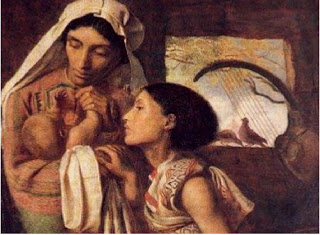
Moses in his Mother’s Arms was painted by the British artist Simeon Solomon (1840–1905)

Easter: Because of Him

One thing that impresses me about the New Testament is just how much Jesus Christ honors women. He clears a lot of things up for those who haven’t showed the proper respect or those who think the scriptures are sexist. From the women he’s known throughout his life to those he encountered on good or bad situations, he showed that women are equal to men.  He gave his life for EVERYONE.

Below is a link that shows the Easter message very well.  My friend, Sam, worked hard on this and it came out great!

https://www.youtube.com/watch?v=_S3TI4bYerU

Easter is such a good reminder of what the Lord Jesus Christ did for us and how we can truly live because of His sacrifice.  Let’s strive to always remember Him.

Images can be found on lds.org and mormon.org. Top image a still from a Bible video, and painting is by Anderson. 


Edward, Mary, and Elizabeth: Sibling Rivalry Gone Wrong

In honor of Siblings Day (which was on April 10, I know), I made sure I posted a pic of me with my bros and sis on Facebook. I believe in eternal families, and I feel blessed with a wonderful family—even if we disagree at times. No family’s perfect, but at the end of the day we still are bounded by blood and there’s love there.

But I’ve decided to focus this article about certain siblings in a family that no one would like to join. This is a true tale of two sisters and their little brother whose tale has been examined and analyzed endlessly.  They each became powerful rulers but at painful prices. They even denied at times that they were blood related, but there’s no question they were. The real question is did they still love each other in the end?

Presenting from eldest to youngest:

Mary, Elizabeth, and Edward.

All children of King Henry VIII’s. But with such a father figure, could the kids build lasting relationships?

Tough Tudor Love

Seventeen-year-old Mary, daughter of Katherine of Aragon, was ordered to recognize her baby sister, Elizabeth, as a princess. But Mary still recognized herself as a princess. But had a hatred been born? Not necessarily.

Mary did hold a grudge against Elizabeth’s mother, Anne Boleyn. Yet some sources say that Mary actually liked Elizabeth and gave her attention and gifts that Elizabeth lacked when their father became interested in a new woman called Jane Seymour.

Shortly after Anne’s beheading, Henry married Jane. She was able to unite Mary and Elizabeth with Henry. She was also able to give Henry a male heir named Edward. Edward’s big sisters played important roles in his life and his christening. Mary (now age 21) was named godmother and Elizabeth (at age 4) carried the chrisom. Sadly, Jane died soon after her son’s birth. Her stepdaughters probably did sympathize with Edward. Their mothers had been taken away from them too.

Katherine Parr, Henry’s sixth and final wife, is credited for bringing the family closer together. But after Henry’s death, the feelings between the Tudor siblings became increasingly shakier. Extreme sibling rivalry took swing.

Conflict of Interest

As a staunch Protestant, the young King Edward pushed to reform England to his faith. It was an especially perilous time for Catholics. Mary, a devoted and famous Catholic considered hiding outside the country. She feared for her life. The two once had been tight.  Now they found themselves in tough spots. Just because she was his sister didn’t provide her life insurance. Edward did sign the death warrant for his scheming uncle, so it was uncertain if Mary would be an exception. Understandably, she avoided court. Running out of excuses to avoid family gatherings, she made an appearance at Edward’s court in Christmas of 1550.

Edward humiliated his sister for beliefs and made her cry; in turn, he also cried. The two kissed and made up, but peace in the Tudor family lasts for only so long.

Not long after, Edward wrote to that she was breaking the law. Her known devotion to her religion was now considered treason. Edward wrote: “I have natural affection for you. Do not seek to diminish it.”

Neither changed their ways.

Toward the end of his life (age 15), Edward crossed out Mary from the line of succession and put Protestant cousin Jane Grey before his sisters.

Pardon Me

Mary rallied troops and Jane Grey was dethroned. Though her cousin was a pawn in others’ agendas, Mary was counselled to behead Jane because of her associations with conspirators.

If Mary could put her cousin to death, could she do the same to her sister?

Elizabeth quickly recognized her sister as queen.  Doubts emerged with rumors of Elizabeth being involved in a plot to dethrone her sister, and Elizabeth was sent to the Tower of London. She feared for her life. (I think this happened before.) The night before her arrest, Elizabeth pleaded her innocence in a letter to Mary and signed it, “You Highness’s most faithful subject that hath been from the beginning and will be to my end.”

That didn’t stop Mary.

Permissions to stop arrest denied, but Elizabeth was granted the finest rooms in the tower by protocol and was proclaimed free to roam in the gardens. Three months later with no proof, Mary was persuaded to let her sister go free. The damage was done, but would Mary have executed her sister?

Edward could have executed Mary but didn’t.  Mary could have executed Elizabeth but didn’t. But nothing was above the Tudors.

Revenge

When Elizabeth took the throne, she undid her sister’s Catholic reform but actually did continue Mary’s plans for fiscal reform and exploration. Sadly though, Elizabeth seemed to have encouraged propaganda that darkened her sister’s name.

But hey, Elizabeth’s reign has been described as “glorious.” Yet, it was still just as dangerous as the reigns before her. No one was safe—especially family members. Elizabeth took a page out of her siblings’ book and beheaded her Catholic cousin, Mary, Queen of Scots, for possibly trying to take her” throne.

When naming her heir, though, Elizabeth named the Scots Queen’s son, James, to rule.

When Elizabeth died, the kingdom was ready for fresh faces and was delighted with a cute family to look at. The head of the family was no other than James, I of England and VI of Scotland.

Giving It a Rest

James made it a point give his mother a proper tomb at Westminster Abbey. Mary, Queen of Scots, would be proud. James made other changes in Westminster that possibly would have embarrassed others.

The Tudor sibs were already suited in Westminster Abbey, but sisters Mary and Elizabeth got shuffled into the same tomb. Maybe James was ensuring that Elizabeth kept her side of the bargain to Mary and really was faithful to her end. The tomb carries a message in Latin. The English translation is:  “Partners both in throne and grave, here rest we two sisters, Elizabeth and Mary, in the hope of one resurrection.”

I wonder how awkward the family reunion after this life really was for the Tudors. Was it as bad as Christmas of 1550? One can hope the siblings cry tears of joy now. Perhaps they still attend family counseling sessions.

Best wishes to Edward, Mary, and Elizabeth. May there be a reconciliation. It would take a miracle, but it’s a miracle that three siblings each ruled England separately—and miraculously didn’t kill each other!


The King and I

Readers doubted Audrey Strange’s theory that the remains of Richard III were located underneath a parking lot. She published an article in the Richard III Society’s newsletter, The Ricardian in 1975, that went against the popular belief that the controversial king had his bones thrown into the river.

I imagine the king that died in the Battle of Bosworth in 1485 was cheering. The idea got picked up momentum over the years backed by research.

Finally 2012, the search to find if Richard III was really buried in a church beneath a parking lot was executed.

It took “four years of fighting” for Philippa Langley to see her goal happen. She had gathered funds and finally persuaded the Leicester City Council to grant permission to tear up a parking lot. She rallied support from the Richard III Society and stayed in contact with those who felt they had enough proof that Richard III was buried in the former Greyfriars Friary Church located underneath a parking lot in Leicester. Understandably, there were skeptics.


Richard Buckley of the University of Leicester Archaeological Services doubted the skeleton of a king that lived in the 1400s would be found. Even though he would “eat his hat” if King Richard III was discovered,  he stilled the join team to search for the king.

“There are people who have these great dreams of finding things. As an archaeologist, I know how many variables there are at play on an excavation. So the chances of finding Richard was a million to one,” Buckley said.


Before the dig was under way, Philippa checked out the neighborhood that the parking lot was meshed in. When she got to the parking lot itself, she noticed a parking space with a painted “R.”  Besides the spot being saved for a living person, Philippa had an “intuition” that Richard’s body would be close to the reserved spot. She recalled, “I got the strangest sensation when I was in that area in that place. I absolutely knew that I was standing on Richard’s grave.”

The very first day of for excavation, a skeleton buried close to the “R” was discovered.

Only minutes after discovering the first skeleton, Philippa described a “paranormal” event. “The biggest darkest cloud came over and there was this incredible, tempest. The tempest arrives the minute we discover human remains. If it was Richard, he was ready to be found. He wanted to be found.”

The days went on with additional discoveries in other trenches. Yet Philippa was sure that the skeleton the team found on day one was Richard. On day 12, Philippa met geneticist, Dr. Jo Appleby and her assistant Dr. Turi King. As Philippa watched the two work in the trench near the “R,” she felt that intuition and was relieved his exhumation would be peaceful. She then realized that it would “be carried out by women. I wonder what he would have thought of that.”

And guess what? DNA tests that corresponded with descendants from his sister Anne of York proved that the skeleton was King Richard III. Now let’s go back to possible thoughts of the king. My theory: gratitude, shock, and awe. Maybe relieved that the men were also involved but still shocked that it had been women who had contributed greatly to his discovery.

Yet, he wouldn’t be altogether surprised.

Richard III’s queen, Anne Neville, showed she was also diligent and aggressive.  Stay in tune to read how Anne Neville was the businesswoman version of Cinderella.

Oh! And p.s.! The doubtful Richard Buckley graciously ate a baked cake shaped like a hat.

Sources: Smithsonian’s Richard III documentary, The King’s Grave by Philippa Langley, Michael Jones

 Featured image of Langley with the reconstructed face of Richard III fromhttp://www.dailymail.co.uk/

Other images from:
http://nerdalicious.com.au/
http://www.richardiii.net/


Shared Names and Letters

I hear my mom’s voice.

“Sarah! Come here! You have got to see this!”

Common comments from my mom preparing for a biography lesson for Daughters of the Utah Pioneers. Though I have mixed feelings about the club, I like how it motivates my mom and others to be detectives. The poor and limited material the members are given causes my mom to really search for the facts. Through her diligence, women in the past have been brought back.

Besides, it’s entertaining seeing Mom getting excited about new discoveries. So during a “come here” moment, she introduced me to Sarah Gordon Guymon. She pointed to a brown and white picture of an old woman on the computer screen. “She shares your name,” my mom announced.

Was I supposed to be excited? It looked like the typical photograph of the olden days that is easy to find online. After I received further information bit by bit, I felt honored to share our first name.

Sarah crossed the plains to Utah at age 59! Wow. I really don’t hear about those kind of success stories especially considering she lived years after she reached the Salt Lake Valley.

Another “come here” moment came when my mom discovered that my dad’s direct ancestor, Hannah Patten, was only one of the few women over 59 in the wagon company. She was 63. No doubt they knew each other. Sometimes you just get those feelings.

I came to know Sarah more when my mom showed me some of her letters. At first, I thought I was in for an “oh that’s nice” moment. But the letters really brought life. The letters were addressed to her sons who didn’t join the Church of Jesus Christ of Latter-Day Saints and therefore, didn’t head west with Sarah and others in the family. She expressed how much she missed them but wanted them to join her if they thought if the trek was worth it.

Sarah understood the principles of her faith. The importance of family, but individuals using their agency. Giving love ones a choice is a Christlike example I hope to emulate.Right then, I knew I wanted to share those same characteristics.Like sharing her name, wouldn’t it be an honor to share those traits?

Thank goodness for people like Mom who really want to know the person behind the name. Such people deserve gratitude. I’m sure that the individual who has passed on wants to give such people an award.


Featured image: pixabay.com