A seven-year-old recently told me that they loved Wicked so much, that they thought watching The Wizard of Oz would be fun. It was the child’s first time watching the 1939 classic—and the child had to turn off the movie because the Wicked Witch of the West was actually scary!
I tried to reassure the kid that the lady who played the witch in The Wizard of Oz was apparently a super nice lady, and the girl who played Dorothy had a hard time acting sacred of her. Not sure if that helped, but the Wicked Witch actress, Margaret Hamilton, who died in 1985, wouldn’t have been surprised.
The author, Dikkon Eberhart, was a kid when his mother promised him he would meet the Wicked Witch. He was so excited that when the time came, his excitement turned to angry disappointment only to see “just a woman” at the door.
He marched to his room. His mother came in, told him to be kinder to their guest, and when she understood how he was let down, apologized and cleared up the situation by explaining this woman was a friend of hers and was a nice woman. So he and his mother went downstairs. Still having doubts, his mother’s friend did the terrifying cackle. Okay, so his mom’s friend sort of sounded like the Wicked Witch, but where was the black hat?
Margaret Hamilton would visit him mother from time to time. He grew to understand that people whom the world thought they knew were “something else” to him and his family.
A Beautiful Day in the Neighborhood
Audiences were spellbound when a friendly, old lady came on to Mr. Rogers show saying that she was the person who pretended to be the Wicked Witch.
This television appearance with our favorite neighbor is a comforting experience.
Margaret gave insight to those who thought the Wicked Witch is very mean. She pointed out how the Wicked Witch “enjoys everything she does” but is “frustrated” and “unhappy because she never gets what she wants.”
She also went through the parts of her costumes—saying it was just like a Halloween costume. No need to be scared.
The way the show was able to have Margaret Hamilton is a sweet story too.
My Favorite Witch
While filming The Wizard of Oz, Judy Garland formed a strong bond with Margaret. Judy Garland’s daughter, Lorna Luft, has gone on the record saying it was challenge for her mom to pretend to be scared of Margaret Hamilton.
Margaret and Judy remained friends well after the filming. While Judy was a guest on the Merv Griffin show in 1968, Margaret stopped by. She was on a way to see a show starring their mutual friend, Ray Bolger—a.k.a. The Scarecrow.
Oh, the irony! But I find the friendship between the two actresses a sweet comedy.
If I showed a child this clip— one who was freaked out by Margaret Hamilton’s portrayal of the Wicked Witch—I suspect the laugh would still scare the child.
But hopefully with time, the child—or even a freaked-out adult—would at least know that the original girl really wasn’t that bad.
I wrote my first Catherine of Braganza post about a decade ago. In it, I expressed how a certain painting of her cracked me up.
“Catherine was bold enough to remind them [mistresses of the King] she was the only one who held the title of queen.
For example, look closely at this portrait.
An accident? It’s almost as if she’s pointing at the crown. Time went on, and most of her portraits included the crown and sovereign orb.”
That painting was still in my mind when doing the collage book. I decided the crown needed to be bigger and more visible.
(Plus the late Elizabeth II’s philosophy about being seen is applicable.)
I hope Catherine wouldn’t mind me adding some sparkly nail polish to her dress and drawing the crown and orb bigger that also includes sparkling jewelry and lace trimming tape. Part of the image she and her advisors stressed was she’s someone who didn’t care about glitzy stuff. But maybe this art work would make it super, SUPER clear that the sitter was truly the top royal woman.
Henrietta Maria, Catherine’s mother-in-law, was a very valuable mentor to Catherine. The Dowager Queen gave tips on how to handle situations with her son and how to throw get togethers.
MOM
Luisa Guzman was sly and knew how to motivate her husband to fight for the Portuguese crown. She was more than just a duchess! She even used a tiny Catherine to persuade him. According to Lillias Campbell Davidson’s biography on Catherine, Luisa hinted how wonderful it would be for their daughter if their family had the crown at two-year Catherine’s birthday party. Then Luisa was clearer when she physically presented Catherine to him. After Luisa got Catherine to kiss him, she’s quoting as asking:
“How can you find it in your heart to refuse to confer on this child the rank of a king’s daughter?”
When it came to the dangers of seeking a crown, she also said something else super important. Her famous quote was something that deserved to be a poster on Catherine’s wall:
How aware was Catherine aware of her mom’s statement I don’t know. But Luisa conducted herself with the attitude behind this quote. I believe her mom’s attitude to fight for her crown did make an impression on her.
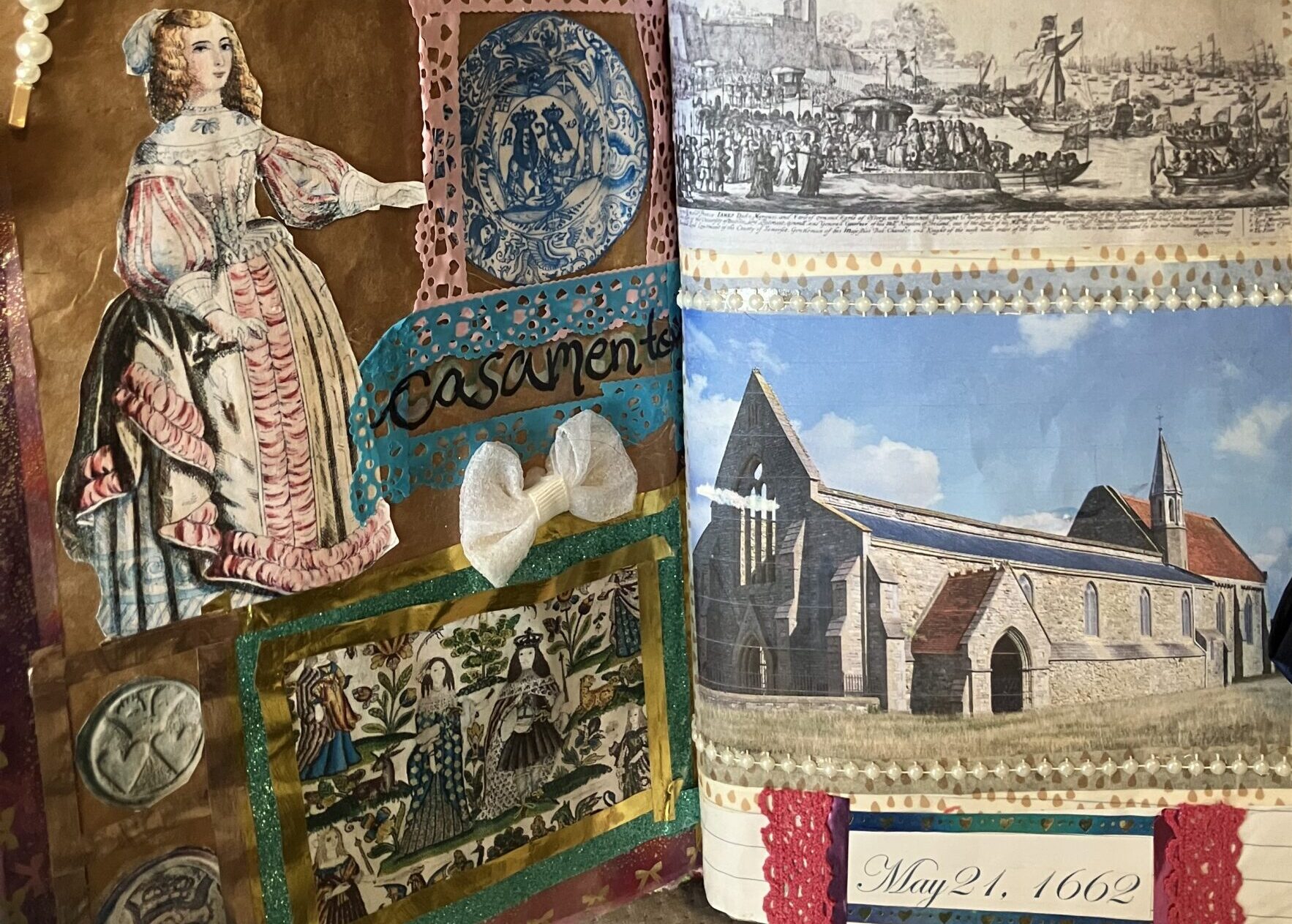
The pages that explore personal sacrifice were a tad bit emotional for me. The top left picture shows Portugal’s grand send off of their infanta to England to become England’s Queen. (I think the artist is Dirk Stoop?) It’s a celebratory moment, but a young woman is still leaving the home she loves.
She was a sacrifice. That’s why the bottom picture is Josefa de Obidos’ painting, The Sacrificial Lamb. (More background on that painting in a future post.)
The right page is an illustration by W. Heath Robinson (1872-1844). (His actual painting is more vibrant, but my printer had low ink levels!)
Thoughts about Beauty and the Beast and Music
The Beauty and the Beast with the familiar French story motifs came into existence in 1740 by Gabrielle Suzanne Barbot de Villeneuve, and then an abridged version by Jeanne-Marie Leprince de Beaumont was published in 1756. But similar fairytale stores stories existed long before the 18th century.
The woman given to a man she never met before is “a tale as old as time” that is actually a straight up fact more than a cliche.
I’ve concluded that these tales have been around for thousands of years not only because the magical and romantic appeal, but because they served an educational purpose: to prepare their daughters to marry strangers for the sake of the family. And for the sake of lands, kingdoms, and countless people who were depending on the marriage for their lives. And I hope the sons listened carefully-make sure you treat your wife kindly, or you might be in danger of losing your life!
I’m not sure if Catherine or Charles heard of these types of tales, but I crazy speculate that if she heard the Broadway soundtrack of Beauty and the Beast, she would have turned up the volume of “Home” (a defiant song Belle sings after she becomes the Beast’s prisoner). Catherine was forced to accept her husband’s mistresses. In the very early days of the marriage, she loudly fought against it. I could see her blasting the song then-and maybe here and there throughout the royal union.
After a twenty-three marriage that included an apology to her from Charles on his deathbed, Catherine wanted to return to her homeland of Portugal. She got her wish seven years later.
This is where I really get speculative:
So the fluff of Disney’s Beauty and the Beast musical and two popular movies crosses my mind at Catherine going back home. The Beast/Charles experience loss and regret.
But getting back to the more serious (but still a little speculative) stuff….
I imagine that freeing Catherine was the best thing Charles could do for her—and he had to help out with that from heaven. Hopefully, he realized that Catherine—in my humble opinion—was the best thing that ever happened to him.
A lot of Catherine’s youth hasn’t been revealed/pieced together that well. It makes me frustrated anyway, but maybe if complied properly, she could have had her own book in The Royal Diaries series.
The next best thing for me was making her a stereotypical teenage, scrapbook type collage.
The biggest thing to stand out is a “speculative” banner that she would have held at a game that says, “LET’S GO WYVERNS.” The wyvern is the mascot of the Braganza House. Family/school spirit!
The busy collage includes possible pics of herself and modern concerts, Portuguese instruments, a modern title page of one of her dad’s musical compilations, and a mysterious and handsome man.
That man was Prince Rupert-a scandalous, handsome pirate, and a cousin to the future Charles II. Prince Rupert was at first welcomed and popular court of the court of King John (Catherine’s dad) but soon became a liability. He would have been a fun character in a fictional royal diary!
Catherine’s “Princess” Moment
I came across a pic that’s identified as Catherine as a young woman.
Portrait of D. Catarina de Bragança, Queen of England and Infanta de Portugal “Painting of Catherine of Braganza, Queen of England and Infanta of Portugal, outside the Royal Pantheon of the House of Braganza, in the Monastery of Saint Vincent Outside the Walls, Lisbon, Portugal.”
Beautiful, but I had to change it.
Originally, I wanted to leave it as is, but I couldn’t tell what was her hair or the background. It drove me crazy. I tried to adjust the lighting of a copy but no deal.
Still, I wanted to use it because it’s so pretty! My modern eyes see it as a being equivalent to a high school senior picture. Maybe it’s her before a homecoming dance or crowned Prom Queen.
So with nail polish, I hope I depicted an appropriate princess moment of the future queen of England.
The Portuguese Princess has landed! The King’s new consort!
England has a new queen-and bride!!!
Citizens were excited to know what she looked like. And many then-like now-were curious and love a royal wedding!
If you were close enough to witness the cute bride, you were gifted a bow from the bride’s wedding dress. What a wedding favor! (And a bit weird.)
Too bad for the country’s subjects (and the international wanna be viewers) that TV wasn’t invented yet to feel like you’re part of the wedding festivities!
Though the new queen wasn’t the best looking in the room, she wasn’t ugly. I think she’s pretty, and the early pics of her in England are adorable!
While I believe she was in a general a good person, her looks led some to underestimate her. A secret weapon.
Throughout the collage book, I gave insight about the propaganda that was useful to Catherine.
One thing that was involved in that propaganda-to her benefit and others’-were her angelic looks.
My own belief is she continued to use her puppy dog eyes to sometimes manipulate and placate the King-especially when she was is in danger.
I speculate all the time what these biographical subjects would like or how they feel. I can’t stand to read a lot of that fluff though, but I thought I’d get out all my fluff in a book…
A glue book!
Or scrapbook…collage book?
Whatever type of book I put together is, it’s part of a genre I call speculative bio.
This book’s official title is called, Catherine’s Collage Collection: The Life of a 17th Century Queen.
The front and back:
The literal base of the book is a composition book. The page trimmings I included were mainly lace, pearl, Washi and beads tapes. I used some scrapbook paper here and there. I’d include some stickers, very few magazines clippings, but I printed off the majority of the pictures myself. (SO many talented artists!)
The book can close thanks to velvet headbands with bows I attached to it. I also added pearl clips and bobby pins. These hair decorations were reflective as the types of outfits the Queen wore (the lace tape is also a callback to Catherine’s outfits, but that stuff was more pricey than the dollar store classy hair accessories!)
I expressed to a friend I probably have all my thoughts and speculations wrong. She pointed out that whatever the case, she was sure the Queen would appreciate the project.
So hopefully the 17th century Queen would enjoy it-and notice that I mindfully didn’t include flower embellishments. Too bad because I love flowers. Though Catherine of Braganza portraits feature flowers, she didn’t always appreciate them. I heard something about how her husband gave bouquets to his girlfriends, and flowers gave her some sort of PTSD. One could hardly blame her.
Though reading about that and her other trials make me so depress, putting together this book was a good antidote. It was actually both really fun and spiritual.
While I did this collage book for and of Queen Catherine, I got the feeling that things worked out for her.
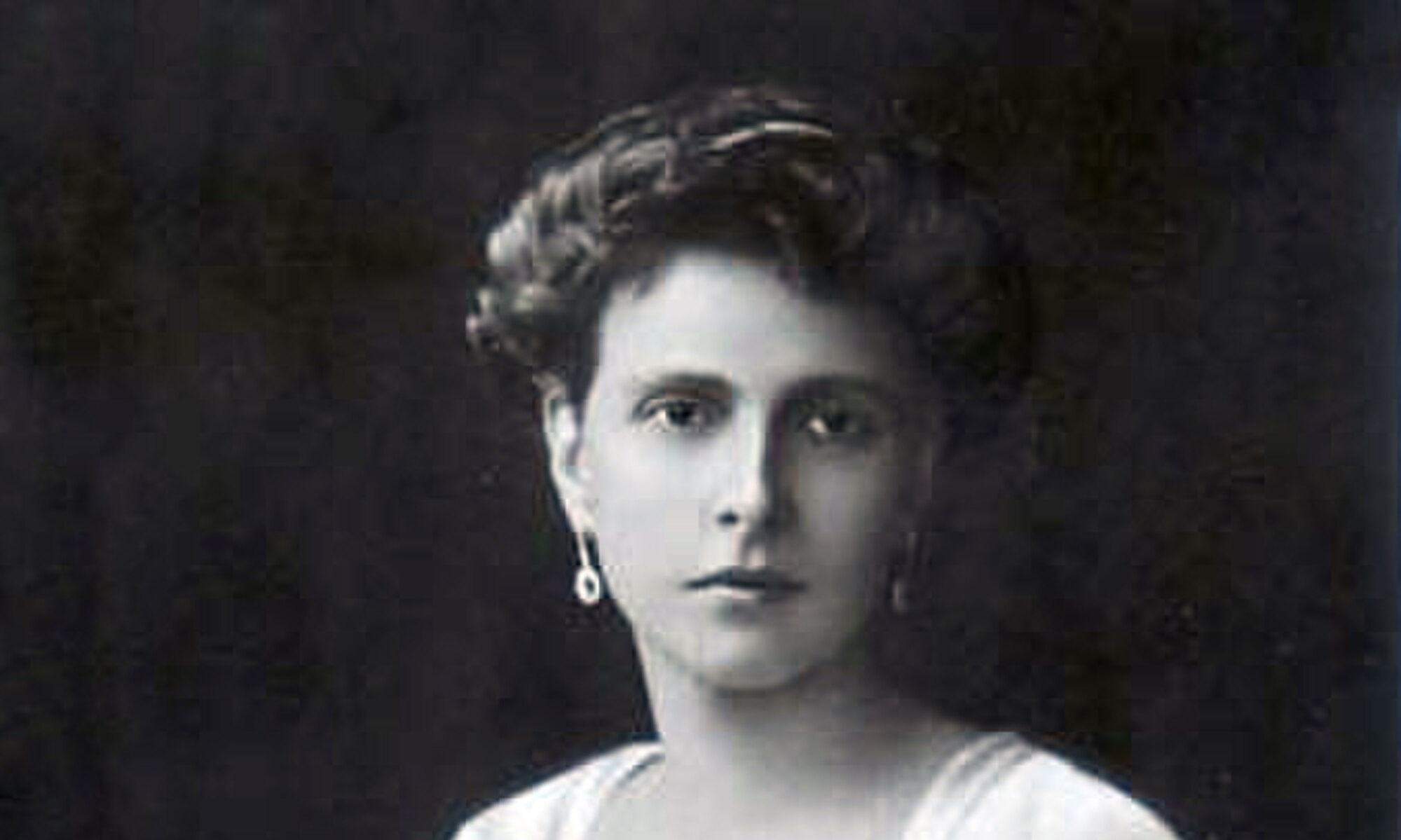
Princess Alice was a unique and remarkable individual. She was born in 1885 in the presence of her grandmother, Queen Victoria, at Windsor Castle.
“The Four Generations” by Gustav Mullins
Baby Alice sits on her mother’s lap. Her aunt is standing, and her grandmother, Queen Victoria, is sitting.
Alice knew four languages, was deaf, and fluent at lip reading. Her marriage to Prince Andrew of Greece and Denmark in 1902 produced a family of four daughters and one son. She went through World War I bandaging up soldiers in war zones, her husband nearly being executed, and the family fleeing in exile from Greece. By 1923, the family were refugees in Paris.
Though the family didn’t have much money, her son, Philip, told biographer, Gyles Brandeth, “My recollection of the 1920s in Paris was that we were a very happy family, and it was a very good time.”
Prince Philip with his mother in 1926.
Princess Alice’s youngest child and only son didn’t know his mother was going through a breakdown. She told people of erratic religious visions. Other family would send her to a clinic where she was forced to have very inappropriate physical treatments. Alice discharged herself from there after a few months. Her mother wasn’t convinced, and arranged Alice to be taken away to a sanatorium in Switzerland. In 1930, Alice was taken away while her mother took Philip on a picnic. Alice felt like a prisoner and even made an escape attempt. She missed all four of her daughters’ weddings. Her son was sent to British relatives and boarding schools. Her husband lived in France with his mistress.
In 1932, Alice was discharged from the sanatorium. She distanced herself from her family and traveled throughout Europe. But she really missed her son though. Alice began exchanging letters with her son and other family members. In 1937, she briefly reunited with her family (including Philip and her estranged husband) for the funeral of a pregnant daughter who–with her husband and other children–died in a plane crash. The family noticed that Alice was back to being mentally stable. She felt needed again.
In 1938, Alice returned to Greece–which now was more friendly to royals. Upon her return to Greece, Alice went to helping the poor and needy. Food soon ran out in Athens. Her brother would send food or money to her but was frustrated that she would give it away.
The Cohens
The Cohens were a prominent Jewish family in Greece with ties to the royal family. As Greek Jews were being rounded up and sent to death camps in 1943, Rachel Cohen and her daughter, Tilde, were hiding in the outskirts of Athens but needed a safer hiding place.
When the Cohens walked passed the royal residence, Alice’s lady-in-waiting came out and greeted them. Alice and the lady-in-waiting had been on the lookout for the family since the day before. Alice was more than happy to taken Rachel and Tilde in. Later, Rachel’s youngest son, Michel, joined his sister and mother in hiding.
The Gestapo had suspicions that Alice was hiding Jews. They heard conversations (Alice and the Cohens) coming from upstairs. When they questioned Alice, she said it was just the nanny and was able to dodge other questions using her deafness as an excuse.
Evy Cohen, a descendant of the Cohens, credits her existence to Alice. She insists Alice’s story must be told. The Cohens applied for Alice to be recognized as one of The Righteous Among the Nations. In 1994, Philip visited his mother’s grave in Israel (yes, I’m jumping ahead a little bit), and at the ceremony honoring her, he commented how Alice didn’t tell her family the story immediately. He said:
“For years, we did not know, and, as far as we know, she also never mentioned to anyone, that she had given refuge to the Cohen family.”
She gave refuge to the Cohen family for thirteen months. By that time, Athens was liberated. Alice continued to stay in Greece, helping out, but made some important visits to Britain.
Going to Britain
One visit occurred in April 1947 when her son got married to Princess Elizabeth. Alice had arranged for some of her few remaining jewels be incorporated in the engagement ring.
When Alice went back to Greece, she decided to become a nun and start an order. Another important visit to Britain was her daughter-in-law’s coronation. Alice showed up in a designer nun’s habit.
When she was back in Greece, she continued to volunteer but found it hard to find women proper enough to become nuns. With her failing health and a royal coup in Greece, Alice was persuaded by Philip and Elizabeth to return and live in England in 1967. She resided in Buckingham Palace and died in 1969.
Shortly before her death, she wrote her son,
“Dearest Philip, Be brave, and remember I will never leave you, and you will always find me when you need me most. All my devoted love, your old Mama.”
Legacy
Before her death, she wished to be buried in Jerusalem. In 1988, her remains that were buried in England were moved to Jerusalem. Since then, her son, grandson, and great-grandson, have visited her grave.
She was recognized as Righteous Among the Nations. In the 1994 ceremony, Prince Philip also said,
“I suspect that it never occurred to her that her action was in any way special. She would have considered it to be perfectly natural human reaction to fellow beings in distress.”
On Holocaust Memorial Day 2025, Prince William gave a touching tribute to Alice:
Princess Alice was one eccentric, brave princess. Her life could have been a tragedy with all it setbacks, but she did overcome them. Her example of service and not giving into peer pressure is a story that really does need to be told.
Princess Andrew of Greece and Denmark by Philip de László, 1922. From Private collection of Prince Philip, Duke of Edinburgh.
Sources
Videos:
In addition to Prince William’s tribute, check these enlightening videos out:
Emilie Pelzl Schindler was born in 1907 in Czechoslovakia. She connected with nature and animals. Life seemed to be pretty good until World War I. Her father served in the army and came back with PTSD. She had to take care of him a lot. So, it’s not really surprising she was ready to get out of her situation when she met the handsome and adventurous son of an electric motors salesman in 1928. That son was Oskar Schindler. After six weeks of dating, the two married.
She was shocked by her new husband’s lifestyle and affairs. She suffered from miscarriages and periods of loneliness.
To the Rescue
Oskar also loved money. He saw that joining the Nazi party provided profiting opportunities. He was able to buy a factory where he hired Jews for cheap labor. As the war progressed, he and Emilie witnessed the brutality of the Nazis and that the Jews were in real trouble. (Her Jewish friend, Rita, had been hung in front of her father’s store.)
She felt she had to do something at the scenes she witnessed:
“I’d seen enough of emaciated bodies, starving children, and desperate mothers.”
Oskar’s factory became a sort of haven for Jews on his list.
The Schindlers used the black market and spent much of their money and valuables for things like food, supplies, and the necessary relocation of the factory and workers. Oskar would go out of town a lot to wheel and deal in order to protect those on the list while leaving the care of the factory to Emilie.
Ludmilla Page said:
“She was wonderful, Mrs. Schindler. She did it in her own quiet way.”
One of the times Oskar was away from the factory, four train wagons of 250 people stopped. The SS officer reported the Jews in these wagons were on their way to a death camp.
Emilie recounted the event:
“We found the railroad car bolts frozen solid…the spectacle I saw was a nightmare almost beyond imagination. It was impossible to distinguish the men from the women: they were all so emaciated – weighing under seventy pounds most of them, they looked like skeletons. Their eyes were shining like glowing coals in the dark.”
Her niece, Gertrud, recalled:
“I didn’t know if they were dead or alive. Even the living looked liked skeletons. Some of them were stuck to the walls. Their hair and skin frozen in place. Aunt Milly had warm water fetch so we could thaw them off. Then we go them out. The sight was horrifying.”
Emilie had a makeshift hospital set up in the factory. She and her husband also set up a Jewish cemetery for those Jews who didn’t survive under their care.
Michael Klein recalled the scene when he was rescued:
“Some people who could still walk, were walked in. Others were carried in to a big room where there are several showers nearby. And the showers were turned on, and hot water was running for the showers. I remember I went to this hot water [that] was running, and I lied down, and I slurped the hot water like a pig. I couldn’t imagine that I will ever see hot water, and it would be warmed.”
Celina Binjaz, who was then 12 when she and her mother were saved from Auschwitz and brought to Schindler’s factory, would be forever grateful for the Schindlers. In her interview, Saved by Schindler’s List, she told how by the time she and her mother reached the factory, her then illness was an enlarged liver. She commented:
“It was only through the good graces of Mrs. Schindler-Emilie-who came with a pot of farina [sort of like a cereal that’s easy on the stomach] that she had cooked herself, you know, and fed us sick people, that we survived, really. Because that was the only nourishment that we got.”
The factories were not luxurious, but the Schindlers did tried their best, and Emilie proved to be a maternal lioness. She got grain by asking (while revealing she was helping out Jews) her next neighbor, a woman who ran a grain mill. She succeeded in that. She did personalized things like getting prescription glasses for a boy who broke his.
Survivor Maurice Markheim remembered:
“She got a whole truck of bread from somewhere on the black market. They called me to unload it. She was talking to the SS and because of the way she turned around and talked, I could slip a loaf under my shirt. I saw she did this on purpose. A loaf of bread at that point was gold. There is an old expression: Behind the man, there is the woman, and I believe she was the great human being.”
Post War
Emilie and Oskar had saved 1200 Jews. Europe was an unsafe place for the Schindlers after the war. (A big part of that was the approaching Russians.)
They found refuge in Argentina. It should have been a fresh start. Oskar tried setting up businesses there but failed. He would abandon Emilie and went back to Europe with his girlfriend (whom he had brought with him to Argentina). Emilie was left to settle his debts. She’d later receive pensions from Israel, Germany, and Argentina as well as security.
Emilie worried she would be forgotten. But the survivors she helped would not forget her!
Survivor Francisco Wichter said,
“As long as I live, I will always have a sincere and eternal gratitude for dear Emilie. I think she triumphed over danger because of her courage, intelligence and determination to do the right and humane thing. She had immense energy and she was like a mother.”
Emilie and Oskar were recognized by Righteous Among the Nations. She was able to return to Europe at the very end of her life and died in 2001 in a Berlin hospital.
It’s important not to forget Emilie Schindler. She is VERY relevant to today. At first she was unaware how bad things were for the Jews, but as she witnessed the atrocities, she knew she had to do something to help. She actually did something about it
As I was going through some old school assignments and art projects, I found an essay from my sophomore of high school on Auschwitz. Two decades ago. In the paper, I mentioned that there were no rebellions in the camp. I’ve learned in recent years, that couldn’t be further from the truth! I’ve learned there were many ways people rebelled in Auschwitz and other Nazi camps.
Very recently, I learned about Polish ballerina Franceska Mann (born Franceska Manheimer-Rosenberg) who was a rising star who got deported from the Warsaw Ghetto.
There are reports of whether she was involved in rebellions helping or betraying her fellow Jews before being deported. What seems to be more clear is that she ended up arriving at Aushwitz on October 23, 1943 on a passenger train.
I was surprised to learn that Mann wasn’t saved for a while longer at the camps. She was beautiful and a little bit of a celebrity. Instead, she and and perhaps 100 other women (depending on account) were sent to the gas chambers.
Again, the story gets a little blurred, but there was some sort of riot that these women started. Here is the most famous one:
Franceska noticed the guards were watching her undress. While the guards were in a trance, she struck a guard’s forehead hard with her Stiletto.
She grabbed his gun and shot two guards. She killed Joseph Schillinger and wounded Wilhelm Emmerich, who walked with a limp the rest of his life.
Franceska’s actions caused the other women to fight the guards. The revolt was shut down, and the women were killed. The details aren’t too clear as there were few surviving witnesses. The main story is that there was a women revolt, and two guards were shot. There was a rebellion which inspired prisoners. She has also inspired art—and even a ballet.
The story of Franceska Mann and the other women uprising is one of the many stories about Jews who fought back, and who didn’t go to their fates as lambs to the slaughter.
With Mother’s Day being last week and wrapping up the subject of Moses in Sunday School, I am going to share part of an article called “Who Do You Admire?” by Brenda Combs
Jochebed, mother to Moses, here is a woman to admire! She had the courage to defy the Pharaoh no less and refused to condemn her son to death as so decreed. In our society we are surrounded with individuals who give in to popularity, fads, whims, and politically correctness but here was a woman who had everything to lose yet willingly put her child first despite what society wanted her to do. She had the creativity to hide him in a basket upon the Nile and care for him once the Pharaoh’s daughter claimed him took him to her heart. She only had him for a short time, but you can bet she taught him of the Lord’s way and loved him completely each and every second she had with him. Finally, she placed her confidence in God after all she could do and her children are examples to all who value strength, integrity, faithfulness and righteousness.
Side Note: I love having discussions with Brenda, and yesterday we talked about the heroine, Rahab, whose bravery helped Joshua and the Israelite army conquer Canaan. And the Bible will continue with women making sure that Israel goes forward.
Coming soon A royal aunt’s sacrifice in the French Revolution. A glimpse at my book in progress about a timeless and biblical princess plus Poet’s Profile.
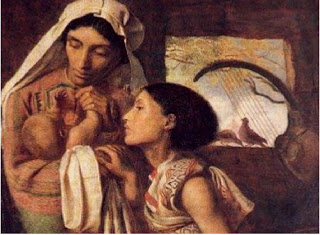
Moses in his Mother’s Arms was painted by the British artist Simeon Solomon (1840–1905)