Category Archives: Mothers

Marie Antoinette and Her Children Painting
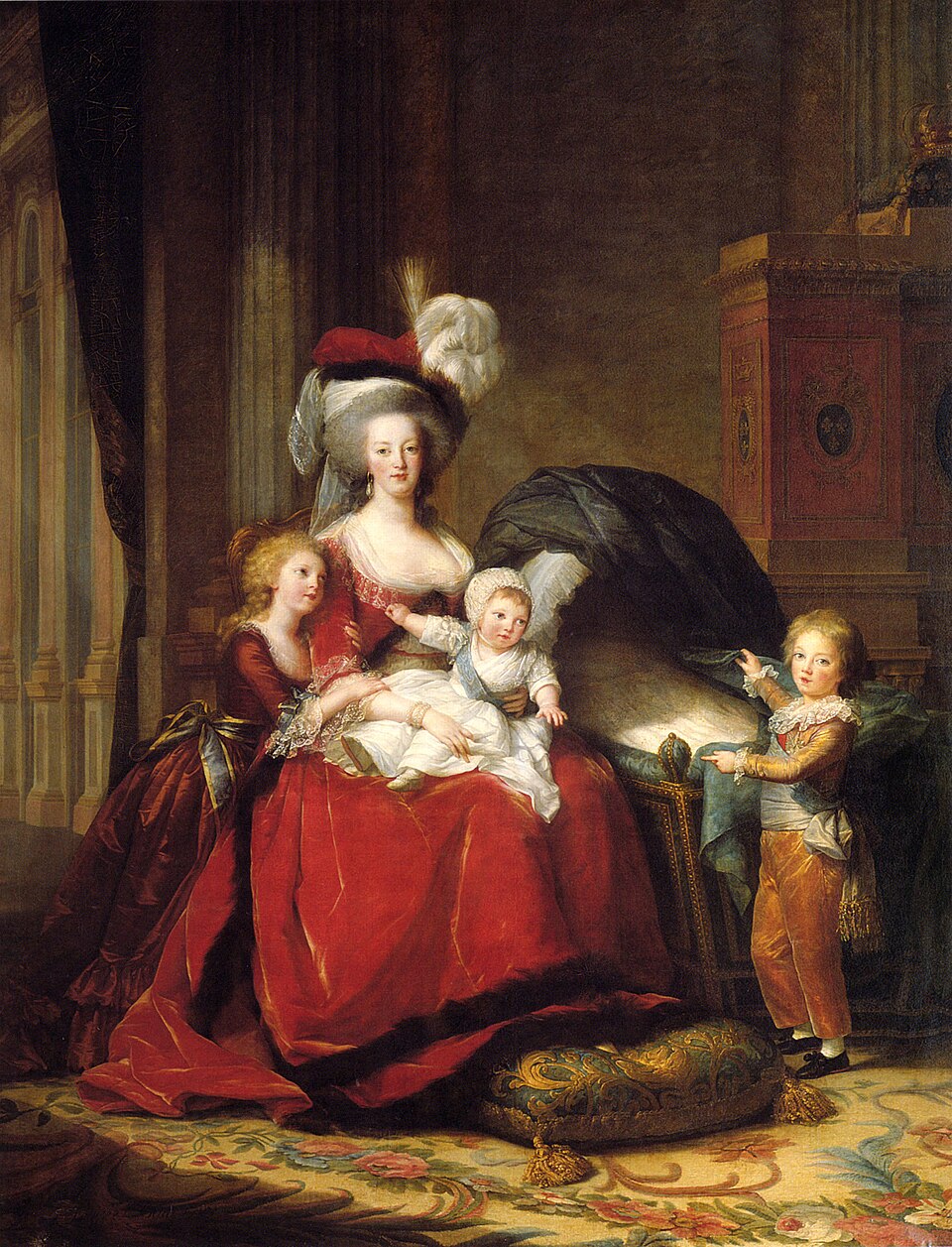
Marie Antoinette and Children, also called Marie Antoinette of Lorraine-Habsburg, Queen of France, and Her Children, was painted by Élisabeth Vigée Le Brun in 1787 and is still used quite a bit in teaching about the French Revolution time period and Marie Antoinette herself. While I’ve always appreciated it as a great art piece, I got bored of seeing it in so many places. It’s beautiful and grand, and her daughter looking longingly at her mother is a little over the top. However, when I learned more details about the painting recently, it became a lot more interesting!

A Daunting Task

Left to right: Marie-Thérèse, Marie Antoinette holding Louis Charles, an empty cradle for baby Sophie (who died before the painting was completed), with Louis Joseph pointing at it. The children outshine the darkened jewelry box at the very right.

Élisabeth Vigée Le Brun had great respect for Marie Antoinette. She started painting her in 1778. They sang duets as the Queen sat for portraits, and both valued motherhood.

Self Portrait with her Daughter Julie (Maternal Tenderness), 1787 by Elisabeth Vigée Le Brun,

In fact, when Le Brun had been pregnant and dropped her art supplies in front of the Queen, she was shocked when the Queen helped her pick up the supplies.

Marie Antoinette was a constant victim of libel, but when Le Brun was approached to make paint a state-type portrait, the Queen’s reputation had recently become more tarnished by the Affair of the Diamond Necklace. (An event where the Queen had been falsely accused of buying–but refusing to pay for–a very overpriced and tacky piece of jewelry.) It was a scary time for the Queen and those associated her. Getting people to see a woman who was a queen and loving mother was no easy task given the circumstances.

The Dress

Marie Antoinette’s red dress is bold but also is a throwback to certain portraits of saintly women.

The first saintly woman is the mother of mothers–Mary, the mother of Jesus.

Madonna of the Meadow-once known as Madonna with the Christ Child and Saint John the Baptist, 1506 by Raphael.

Then a tribute to Queen Marie (Marie Leszczyńska–her husband’s grandma), who was known for her piety.

Portrait of Marie Leszczyńska, 1748, by Jean-Marc Nattier

Featured Jewels

Simple pearl earrings are the only jewelry the Queen is wearing–despite the big jewelry in the corner that I hadn’t noticed before I researched this painting.

The jewelry box is present but hardly noticable. Marie Antoinette’s real jewels were her children.

This is reflected of a woman named Cornelia who lived in ancient Rome and mother of the Gracchi brothers. When her friends asked about her clothes and jewelry, she showed her children and answered, Haec ornamenta mea,” translated into:

“These are my jewels.”

Cornelia, Mother of the Gracchi, by Noël Hallé, 1779

Reception

The reaction to the painting was mixed. Her friends and brother told her the painting would receive “universal acclaimed.” It’s true—as mentioned before, it seems like it’s almost over used. But it’s easily recognizable and will continue to be used as a featured image in educational materials as well as merely showcased.

Going back to the time the painting was completed, it was showcased prominently in Versailles. However, it was moved to a less frequented place after the death of the Queen and King’s oldest son, Joseph (who’s pointing to the empty cradle of his deceased baby sister, Sophie) out of grief. (Marie Antoinette let Le Brun know about the action.)

Knowing the backstory–and the fates of those in the pictures–is heartbreaking and moving.

Hopefully, more people will know of the significance of the painting. If anything, may generations know that Marie Antoinette’s children were truly her most valued jewels.

The Queen’s Name

The queen’s name is precious to me.

Louis XVI

My tenth grade word history book inferred Marie Antoinette was a careless spender. A novel I read in college portrayed her as a loose woman.

Of course that’s been years, and through surprising study and realizations, I came to discover that the messages those writers conveyed were lies. I usually roll my eyes every time a piece of entertainment comes out about Marie Antoinette because it includes slander–and the filmmakers make lots of money from it.

Usually, I can get over it to a reasonable degree. After seeing a recent trailer, though, I can’t this time. I immediately wanted to find production and say:

In the name of all that’s good, stop!

Stop defaming the name of Marie Antoinette.

Stop defaming the name of her husband, Louis XVI.

Stop defaming the names of their faithful friends and family.

Stop it!

As an American, I feel a strong inclination to make these strong requests. Marie Antoinette and Louis XVI contributed generously to the Americans during the Revolutionary War. I enjoy many freedoms, and so I feel that Marie Antoinette and Louis XVI’s efforts should be recognized and honored—and no more lies!

To those in the entertainment industry, academic circles, and different types of influencers  who encourage these crude rumors–please, please stop.  


“Portrait of Marie-Antoinette at Temple” by (maybe after) Alexander Kucharsky

From Maria Anna to Martha: 5 Influential Piano Gals

Life would be a dark place if it weren’t for music. But thanks to creators of music, my world is a happier place. I’m indebted to so many but I have to say there are some standouts that paved the way for my love of music. Maria Anna Mozart, Fanny Mendelssohn, Clara Schumann, Jane Bastien, and Martha Patten.

Maria Anna Mozart

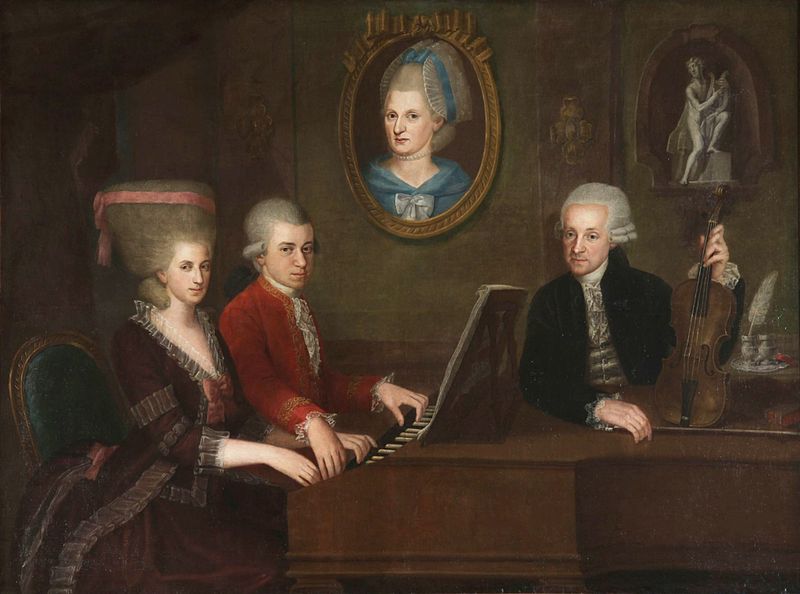
The two prodigy siblings. Wolfgang was inspired by his big sister, "Nannerl" Anna Maria

The two prodigy siblings. Wolfgang was inspired by his big sister, “Nannerl” Anna Maria

When we hear “Mozart,” don’t we think of the boy? Wolfgang Amadeus? We don’t think of  his talented sister Anne Maria Mozart as much.  Smithsonian  magazine called her “The Family’s First Prodigy.”

Her father, Leopold–a court musician and teacher to his children–took them on tour across Europe. The trio was a hit and the siblings made a good team. She was considered one of the greatest pianists.. However, Leopold pushed more for his son’s performances as it was easier for males to break into a professional music career.

Wolfgang saw Anna Maria as a role model. She accompanied him and played his compositions. She also wrote her own, which we sadly don’t have today. But we do have their letters and her diaries which display affection and eccentricity.

I can only imagine her reactions when she opened to write in her diary and found that her brother was at it again. Pretending to be her and writing  irreverent language that I rather not repeat.


Fanny Mendelssohn

Portriat of Fanny Hensel 1842 by Moritz Daniel Oppenheim

Another  equally talented sister. She composed over 460 compositions and sometimes they were attributed to her brother, Felix, because it just wasn’t proper for a woman to publish music. Felix, though,  corrected Queen Victoria that a piece she was fond of was not by him but by Fanny.

She said that one of her piano works, The Year, was for “home use entirely.” Of course it wasn’t, but I’m sure she gave informal concerts to her family that the world will never know.

Clara Schumann

Drawing of Schumann

Clara was romoted by family and friends but had a mind of her own and showed the world that women are master performers too.


Clara’s career was promoted by her father and associates but had a mind of her own. She took the opportunity to show the world that female pianists can be equal to men. I thank her for that.

I’m not sure if I would have gotten along with her, though. But it was nice of her to promote the career of her husband, Robert. I also have to laugh that while he was a student and guest of her father, Robert scared her by popping out of nowhere dressed as a ghost.  She wouldn’t fall in love with him til later,  but perhaps that’s when the sparks started to fly,

Jane Bastien

Everyone in my piano teacher’s studio knew I was on the lowest piano level. (Some things haven’t changed much.) Even when I was promoted to second on the program, it was common knowledge.. For years, I was playing pieces by either Jane or James Bastien. When I saw other names such as Mozart, Beethoven, Schumann, I longed to be playing those composers—or any other composer however obscure. Anyone but Bastien.

HOWEVER……..

Jane Bastien is still one of my favorite composers. It’s evident in the Bastien teaching books that she’s a brilliant teacher. Thanks to her I was wowed and inspired by the other students who went up on stage playing songs by composers whose names I couldn’t pronounce.

I remember bits and pieces from other famous composers’ songs I eventually played, but I remember the very first piano song exactly  I performed in my piano teacher’s annual recital—which of course was a Bastien song.

I became really excited when Jane Bastien was in a piano convention center in San Diego.  She was a gracious, smiling woman, and I got to take a picture with her. Believe me, I couldn’t have been more ecstatic to meet her than meeting the Mozarts themselves.

Martha Patten

I'm honored my favorite pianist happens to my mom. She could have made bucks but continues to share her expertise and expression music with others. Here she is teaching a grandchild.

I’m honored my favorite pianist happens to my mom. She could have made big bucks but continues to share her expertise and expressive music with others. Here she is teaching a grandchild.


A Broadway performer said my mom could have made a lot of money if she moved to New York. My  mom can play by ear, improvise, transpose music into  different keys in a matter of seconds.

The piano could be considered her unofficial sibling when she grew up. Piano and clarinet are her specialties, but she can pick up other instruments. She taught band, choir, drama, and private piano lessons. Her students are complimentary of her and  have invited her to watch them in performances. One student, now a junior high school history teacher, puts on an annual medieval faire in which his students get into character and show the oddities of the Middle Ages. At the beginning of one of his faires, he told the audience how he couldn’t remember much of what he learned in middle school but could remember the words to “76 Trombones” and then announced the presence of my mom.

I can’t count how many times she accompanied a variety of groups–school plays, choir, church functions, talent shows, weddings, and just all type of revenues. I know if my lifetime, she’s played and performed for hundreds of people. So I’ll just say thousands.

Her genius is impressive, but her trademark is how she makes the individual feel. I’m honored that I get a front row seat and hear her best performances–which are played at home.

By the way, she has composed but they are usually “for home entirely.” But my favorites are “Crib Lullaby,” “One By One and Two By Two,” and “No Tail.”


Sources and Links:
http://www.pianowomen.com/

http://www.smithsonianmag.com/arts-culture/maria-anna-mozart-the-familys-first-prodigy-1259016/?no-ist

Wikipedia

http://historyweird.com/1780-mozart-trolls-his-sister/

Images:
Mozart Family Portrait by Croce
Wolfgang and Nannerl Mozart by Eusebuis Johann Alphen
Portriat of Fanny Hensel 1842 by Moritz Daniel Oppenheim
Drawing of Schumann
Grandma Teaching another Prodigy courtesy of Douglas Patten