Tag Archives: Catherine of Braganza

Biblicial Heroines Vashti and Esther: Court Life Has Always Been Controversial and Cruel

Royals. Love them or hate them-they’re an enigma. Tons of debate about their behavior, clothes, and marital problems have been present in the tabloids for years. The Bible also includes royal gossip–and its damages. Here are some of my thoughts about the decisions of the biblical queens Vashti and Esther.

Vashti

Vashti Refuses the King's Summons, painting by Edwin Long

Vashti set a good example by not appearing to the king and his fellow drinking buddies


As a girl, I would have to squint my eyes a lot.
I still do.

I found myself squinting when hearing people tell the story of Esther:
“It starts out with a wicked queen.”

Okay…so I looked it up. The Bible doesn’t refer to Queen Vashti as wicked. This is what happened…

There’s a party, and Queen Vashti doesn’t come before her husband when he orders her. His male guests have been drunk for “many days, even an hundred and fourscore days.”  Plus some scholars think that the king just wanted her to come with nothing but her crown on.

So Vashti doesn’t come. A dangerous thing to do, but think about it. What perverted thing was likely to happen if she had come—appearing undressed—to a party full of drunk men?

Enter villains: The king (a quasi-villain and weak character) with his advisers—the( not-so) “wise men.”

According to them:

“Vashti the queen hath not done wrong to the king only, but also to all princes and to all the people that are in the provinces of the King Ahasuerus.

For this deed of the queen shall come abroad unto all women, so that they shall despise their husbands in their eyes…likewise shall the ladies of Persia and Media say this day unto all the king’s princes, which have heard of the deed of the queen. Thus shall there arise too much contempt and wrath.”

Faced with an unfair request, Vashti had to chose between losing her dignity or losing her life.

Faced with an unfair request, Vashti had to chose between losing her dignity or losing her life.

The men felt threatened by women. They felt that Vashti set an example for women—women could stand up to their husbands. Vashti was deposed as queen; Rabbi David Eldensohn believes she was killed.

It didn’t matter what Vashti did. I don’t mean for the following comment to be irreverent but whatever decision Vashti made, she was—in one way or another—going to get screwed.

Showing up (possibly with no clothes) in front of men who were drunk for  months—something was bound to happen. No parent would want their child to go to a party like that.

( Please watch Pastor Mark Driscoll’s heartwarming take on Vashti’s decision.  🙂 )

72px-Rose_of_sharon_Icon.svg

Esther

Queen Esther by Edwin Long

Esther mustered up the courage to do things she was inclined, yet scared to do.

The advisers told the king to gather virgins throughout the land and add them to his harem. The king was “pleased” with this idea. (Perverted.)

So Esther now is chosen as Queen. When I first started noticing Vashti’s situation, I couldn’t help but be a little disappointed with Esther. In the Old Testament, time and time again, they stress the importance of Israelites marrying in the Covenant. Esther did not. She married a man who didn’t even share her same standards.

I had a change of heart, however, when driving home one night. My mind wandered about the queens and princesses blog posts. I thought of how long I procrastinated bringing up Vashti and Esther. I thought of Catherine of Braganza and a comment by her biographer, Lillias Campbell Davidson, who said Catherine “lived in her husband’s court as Lot lived in Sodom.”  I to thought myself, “No, Catherine lived in here husband’s court as Esther lived in her husband’s court.”

Queen Esther and Queen Catherine of Braganza both had similar, selfless agendas

Like Queen Esther,  Queen Catherine of Braganza also had an  agenda to save lives

Two religious queens living in an immoral court for the sake of protecting their nations. It’s not totally right, but in a way it is noble.

The Jews were relying on Esther to stay queen so they could survive. But she had to find ways to survive if she was going to save their lives.

72px-Rose_of_sharon_Icon.svg

What would you do if your nation was in danger? If marriage was an option over bloodshed, would you marry even a fool?

Fortunately for Esther, she wasn’t ordered to appear in front of people indecent, and remembered her faith

The other woman in the story, Vashti, was asked to do something where her actions would most likely lead to death or sexual assault.

Examining their specific circumstances, we see both women were put in unfair situations. Their behavior was examined during their lifetimes and continues thousands of years later. Read the Book of Esther and see if you don’t agree with me. Keep in mind the queens’ specific situations and outcomes. Both queens were faced with decisions that no one should ever have to make. If you were in either of their place, what would you have done?

72px-Rose_of_sharon_Icon.svg

Sources:
The Book of Esther

Persian Queen Vashti is Killed 2500 years ago – The first feminism? (video)

Vashti made a noble, courageous, brave, moral decision (video)

http://www.pepysdiary.com/encyclopedia/2381/

Images:
Queen Vashti Deposed by Ernest Normand
Vashti refuses the King’s Summons by Edwin Long
Queen Esther by Edwin Long
Catherine of Braganza by Jacob Huysman


Keeping Up Appearances: Catherine of Braganza, Charles II’s Underestimated Wife

Game Face

I love it when the “just there” players in reality TV shows make it to the end—and win. Their opponents hadn’t realized they were making moves the whole way. One “just there” historical player is Catherine of Braganza. She played one of the best games in the history of queens vs. mistresses.

It’s easy to overlook the Portuguese princess who married Charles II in 1662. Oh that shameless Charles II. He restored the English monarchy but any wisdom he possessed was overshadowed by his foolishness. The Merry Monarch openly had mistresses and acknowledged his illegitimate children. They even received more attention and had greater political influence than his wife.

“Poor Catherine” and “pity” are the phrases included in articles about the Queen of England. I had similar reactions at first. Catherine was a tender wife. I believe she would not want to be remembered as the pitiful queen who, at best, brought the tradition of tea drinking to England. I think we’ve been deceived. 

We can only feel a little bit of her great pain, but we need to focus on her practical side. What was her agenda?  Why did she stay in a marriage where she was rejected? How did she do it? She had her reasons for staying. After Charles’ death, she wrote to her brother that she married the king for the sake of Portugal. Portugal relied on the marriage alliance for protection.  Catherine had a lot riding on her shoulders.

Escaping Death and Divorce

Catherine got sick from pressures expected of her. She suffered three miscarriages and caught an illness that temporarily left her deaf loss and unable to walk. Good thing she recovered. She loved dancing and continued to enhance the quality of Italian music in the catholic friary she built. Technically British monarchs were not supposed to be practicing Catholics go there but she practiced her religion anyway. She was definitely in danger of treason, though, when she was accused of planning to poison the king along with other conspiracies. King Charles didn’t believe the accusations against his wife and ignored suggestions to divorce her. He said, “She could never do anything wicked, and it would be a horrible thing to abandon her.”

“A Picture is Worth a Thousand Words”

She might have had trouble learning English, but she found ways to communicate and change people’s perceptions. Catherine literally painted herself out to be a saint. After she was painted as St. Catherine, other women at court followed suit. Some of the mistresses attempted at being depicted as heavenly but it wouldn’t do. They had influence in government but Catherine was bold enough to remind them she was the only one who held the title of queen.

For example, look closely at this portrait.

390px-Catherineof_Braganza wikicommons

An accident? It’s almost as if she’s pointing at the crown. Time went on, and most of her portraits included the crown and sovereign orb.

Catherine worked hard on her public image of being a pious woman (but she also loved to party), and conveyed the message that she was still the queen.

The person she needed to convince most was the king. Though he had many mistresses, he viewed the queen as infallible.

The King’s Apology

Part luck, part strategy, and all miracle, Catherine outlived her husband by twenty years. She must have been envied—and admired—by past queens when her husband actually asked for her forgiveness on his deathbed. She sent a message: “to beg his pardon if she offended him all his life.” He said “Alas poor woman! She asks for my pardon? I beg hers with all my heart, take her back that answer.”

Sweet and Sassy

Catherine had been Charles’ angel, but others saw her as someone difficult to work with. Before Catherine returned to Portugal, she stayed in England to pursue a lawsuit. She was determined to get money back from a former chamberlain who neglected her finances. She proved she hadn’t come all the way to a foreign country over two decades just to be cheated on!

Catherine’s current chamberlain worked closely with the now dowager-queen. He took the blame for Catherine’s actions when Mary II found out that Catherine forbade the chapels at Somerset House to say prayers for King William. William once tried to get Catherine out of Somerset House, but Catherine reminded him she was protected with certain rights. It took Queen Mary to talk through things with Catherine.  Finally it was agreed upon that it would be best if she returned to Portugal.

She Rules!

Catherine was greeted like a hero when she returned to Portugal, She assisted her brother ruling as regent. Her rule included victories over invading threats. One of her greatest victories though, was acting as a mother figure to her motherless nephew.

So, here’s a queen of two countries, who didn’t produce an heir, and surprisingly, didn’t get a divorce. She was accused of treason, but stayed alive well after her husband’s death. Catherine, the queen of England and Portugal, proved to be a capable leader and mother figure. The odds were against her, but she came up on top.

The Catherine Club

Catherine of Braganza shared more than just her namesake with some of the Catherines that graced England’s royal scene. .

425px-CatherineAragon Catherine of Aragon. Aragon was 23 when she married Henry VIII. Braganza was also 23 when she married Charles. Both marriages lasted about 23 years. Aragon lost her husband through annulment and Braganza lost her husband through the king’s death.


Catherine_Parr_from_NPG_croppedCatherine Parr. Henry VIII’s sixth and final wife who’s also known as the one who survived. She and Braganza experienced rumors of divorce and accusations of treason. Despite threats, they both ended up finding favor and outlived their kings.

182px-Catherine,_Duchess_of_CambridgeKate Middleton.   Perhaps the Catherine that Braganza identifies with most. The now Duchess of Cambridge will be the first British queen to be named Catherine since Braganza. She is also married to the first direct descent of Charles II expected to inherit the throne.

CatherineofBraganza In Black (2)Though Charles II had many illegitimate children, they weren't entitled to the throne. It would be over three centuries before a direct descendant would be eligible to be king.

William_and_Kate_wedding

What would you like to see or learn about Catherine of Braganza? You can leave a comment or email me (Sarah) at herstoryline@gmail.com.

Image credits:
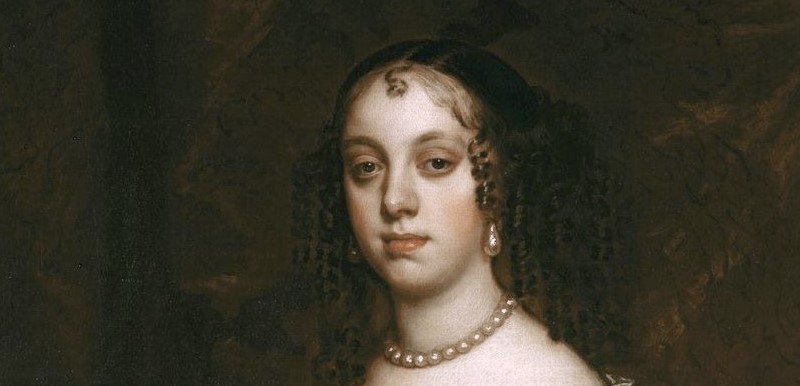
Queen Catherine of Braganza (featured image) by Peter Lely
Catherine of Braganza, Queen of England (pointing to crown) by Jean Baptiste Gaspars?
Catherine of Aragon by Michel Sittow
Catherine Parr by William Scrots
Catherine,  Duchess of Cambridge
Catherine of Braganza (in black) by Peter Lely
Charles II in the robes of the Order of the Garter, by John Michael Wright
The Royal Family on the Balcony 

Further Credits:
Catherine of Braganza: Charles II’s Queen by Hebe Elsna

 Catherine of Braganca: Infanta of Portugal and Queen-Consort of England By Lillias Campbell Davidson

Lives of the Queens of England from the Norman Conquest By Agnes Strickland, Elizabeth Strickland

Catherine of Braganza by Thomas Fredrick Tout

http://www.queensroyalsurreys.org.uk/queen_of_reg/catherine.html

http://en.wikipedia.org/wiki/Catherine_of_Braganza