Category Archives: American Revolution

What Does “Remember the Ladies” Really Mean?
Remember the ladies.

Abigail Adams, First Spouse Coing reserve from US Mint Pressroom

If you haven’t noticed, I’ve used Abigail Adams’ famous line, “remember the ladies” to mean remember gals in history—and sometimes my own personal soapbox.

The image of Abigail hoping her husband, John, could persuade his fellow congress members to let women vote is a powerful one.

Declaration of Independence by John Trumbull, 1819

But Abigail wasn’t saying women should get a vote.

I came across a podcast called, There’s More To That (podcast on the Smithsonian online magazine) which had an episode called, “The Real Story Behind Abigail Adams’ ‘Remember the Ladies’ Letter” hosted by Ari Daniel with guest, Cassandra Good. I really, really recommend it!

Cassandra Good tells how women were part of the action during the American Revolution. However, during this time period, women didn’t have many rights within marriage. Good explains:

“Her specific ask here in ‘Remember the ladies’ is protect women’s rights legally within marriages so that they cannot be abused by their husbands. That’s the direct ask.”

It’s important that this whole letter be examined so we can see that “direct ask”. You can read the whole letter here.
Abigail dated the letter March 31, 1776, which ends with “Remember the Ladies” passage. The same letter picks up on April 6 about other matters.

Here are the paragraphs about our subject (original spelling and punctuation kept):

Tho we felicitate ourselves, we sympathize with those who are trembling least the Lot of Boston should be theirs. But they cannot be in similar circumstances unless pusilanimity and cowardise should take possession of them. They have time and warning given them to see the Evil and shun it. — I long to hear that you have declared an independency — and by the way in the new Code of Laws which I suppose it will be necessary for you to make I desire you would Remember the Ladies, and be more generous and favourableto them than your ancestors. Do not put such unlimited power into the hands of the Husbands. Remember all Men would be tyrants if they could. If perticuliar care and attention is not paid to the Laidies we are determined to foment a Rebelion, and will not hold ourselves bound by any Laws in which we have no voice, or Representation.

That your Sex are Naturally Tyrannical is a Truth so thoroughly established as to admit of no dispute, but such of you as wish to be happy willingly give up the harsh title of Master for the more tender and endearing one of Friend. Why then, not put it out of the power of the vicious and the Lawless to use us with cruelty and indignity with impunity. Men of Sense in all Ages abhor those customs which treat us only as the vassals of your Sex. Regard us then as Beings placed by providence under your protection and in immitation of the Supreem Being make use of that power only for our happiness.

18th Century Letters, Gemini AI

Good says that John’s “dismissive” of this whole conversation:

And she’s annoyed by this. And then he says to another man he’s writing with later, “Yeah, there’s no way we would do that.”

It was a different time period, and John wouldn’t have been the only man to scoff at Abigail’s ideas of giving women such rights within marriage or that women would rebel against their husbands. That being said, John and Abigail seem to have had a strong marriage. It’s somewhat of a paradox. Perhaps he wasn’t always aware of the many ways women can rebel against their husbands. Or maybe he assumed other marriages had the mutual respect like his and Abigail’s did.

The eighteenth century was revolutionary—especially when it came to love. Romantic love within marriage was a radical concept. Marriages had tended to be a mere business interaction before that.

Abigail never called her husband, “my master.” Some of John’s names for his wife included Portia and even Miss Adorable. She sometimes referred to him as Lysander. But the name that stands out most in their letters?

Friend.

Even the “Remember the Ladies” letter—where Abigail goes off on tyrannical husbands— ends with her signing off as “friend.” The way she and her husband saw each other —as equals and friends—would continue. John was never her master. It’s sad not all marriages have that attitude. The exact closing phrase:

Adieu. I need not say how much I am Your ever faithfull Friend.

How much Abigail and John Adams valued each other is an example why we need to remember the ladies and include the men.

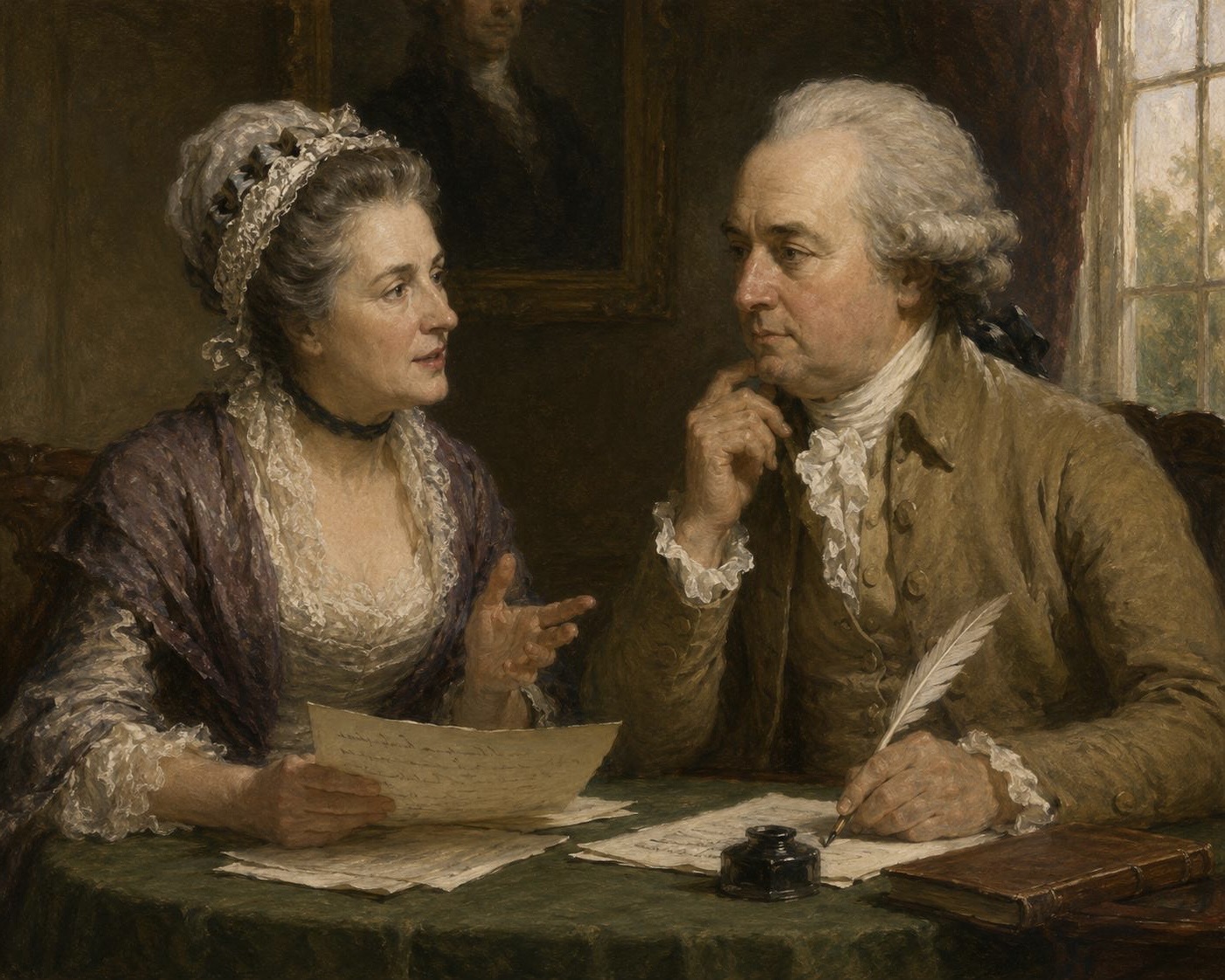
John Adams and Abigail Adams Talking, ChatGPT AI