Tag Archives: Marie Thérèse of France

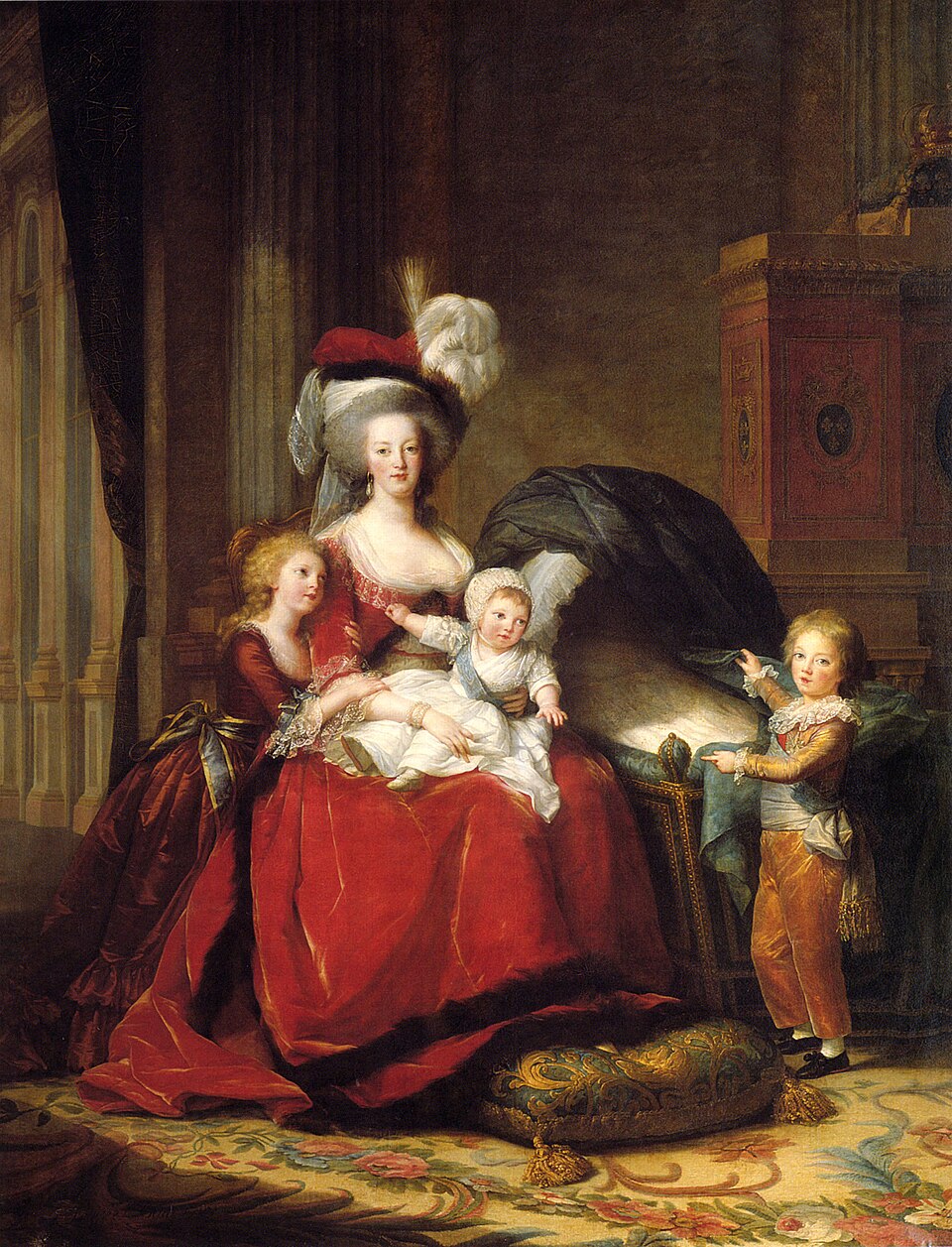
Marie Antoinette and Her Children Painting

Marie Antoinette and Children, also called Marie Antoinette of Lorraine-Habsburg, Queen of France, and Her Children, was painted by Élisabeth Vigée Le Brun in 1787 and is still used quite a bit in teaching about the French Revolution time period and Marie Antoinette herself. While I’ve always appreciated it as a great art piece, I got bored of seeing it in so many places. It’s beautiful and grand, and her daughter looking longingly at her mother is a little over the top. However, when I learned more details about the painting recently, it became a lot more interesting!

A Daunting Task

Left to right: Marie-Thérèse, Marie Antoinette holding Louis Charles, an empty cradle for baby Sophie (who died before the painting was completed), with Louis Joseph pointing at it. The children outshine the darkened jewelry box at the very right.

Élisabeth Vigée Le Brun had great respect for Marie Antoinette. She started painting her in 1778. They sang duets as the Queen sat for portraits, and both valued motherhood.

Self Portrait with her Daughter Julie (Maternal Tenderness), 1787 by Elisabeth Vigée Le Brun,

In fact, when Le Brun had been pregnant and dropped her art supplies in front of the Queen, she was shocked when the Queen helped her pick up the supplies.

Marie Antoinette was a constant victim of libel, but when Le Brun was approached to make paint a state-type portrait, the Queen’s reputation had recently become more tarnished by the Affair of the Diamond Necklace. (An event where the Queen had been falsely accused of buying–but refusing to pay for–a very overpriced and tacky piece of jewelry.) It was a scary time for the Queen and those associated her. Getting people to see a woman who was a queen and loving mother was no easy task given the circumstances.

The Dress

Marie Antoinette’s red dress is bold but also is a throwback to certain portraits of saintly women.

The first saintly woman is the mother of mothers–Mary, the mother of Jesus.

Madonna of the Meadow-once known as Madonna with the Christ Child and Saint John the Baptist, 1506 by Raphael.

Then a tribute to Queen Marie (Marie Leszczyńska–her husband’s grandma), who was known for her piety.

Portrait of Marie Leszczyńska, 1748, by Jean-Marc Nattier

Featured Jewels

Simple pearl earrings are the only jewelry the Queen is wearing–despite the big jewelry in the corner that I hadn’t noticed before I researched this painting.

The jewelry box is present but hardly noticable. Marie Antoinette’s real jewels were her children.

This is reflected of a woman named Cornelia who lived in ancient Rome and mother of the Gracchi brothers. When her friends asked about her clothes and jewelry, she showed her children and answered, Haec ornamenta mea,” translated into:

“These are my jewels.”

Cornelia, Mother of the Gracchi, by Noël Hallé, 1779

Reception

The reaction to the painting was mixed. Her friends and brother told her the painting would receive “universal acclaimed.” It’s true—as mentioned before, it seems like it’s almost over used. But it’s easily recognizable and will continue to be used as a featured image in educational materials as well as merely showcased.

Going back to the time the painting was completed, it was showcased prominently in Versailles. However, it was moved to a less frequented place after the death of the Queen and King’s oldest son, Joseph (who’s pointing to the empty cradle of his deceased baby sister, Sophie) out of grief. (Marie Antoinette let Le Brun know about the action.)

Knowing the backstory–and the fates of those in the pictures–is heartbreaking and moving.

Hopefully, more people will know of the significance of the painting. If anything, may generations know that Marie Antoinette’s children were truly her most valued jewels.

Poet Profile: Princess Marie-Therese of France

Marie-Therese did not like to think of the time she spent in the cell and would not like to be remembered for being a prisoner in it for so long. Hopefully, she wouldn’t mind being regarded as an example on how to deal with loneliness and painful circumstances.

In an earlier article, I wrote about her aunt Elisabeth helping her find ways to cope and what to do when she was completely alone. Her aunt advised her to keep quiet around guards, When Marie-Therese was alone and needed to voice her frustrations, she turned to writing. Writing was a means of survival. She called herself “the most unhappy creature in the world.” No matter how depressing her writings, writing kept her from going totally insane.

Reading Treasures: A Retreat for Everything Marie Antoinette  included a translation of some of Marie-Therese’s poetry in their post called  “I was your king’s daughter:the poetry of Marie Therese Charlotte in captivity” Her poem “I Was Your King’s Daughter” was found in a book kept by  family of Madeleine Bocquet-Chanterenne. The translation in English reads:

I was your king’s daughter
separated from all my family.
I languish in this sad jail
Alas! I say with good reason
Even though I am alone and sad
My jail would appear happy to me
If I was in this place with my brother.
To my mother, to the Conciergerie
I asked to be reunited
But as an answer, my jailers
Say: this has nothing to do with us.
Spread your blessings on her,
God! Open promptly your jail.
A short time ago, at night
I was sleeping peacefully in my bed.
I got suddenly woken up
By the enraged noise of my locks.
They were coming to my door, they were knocking.
I replied immediately: who is there?
I was asked to open up, I replied:
I am getting up and leaving my bed.
I was hoping that I would get out,
I was expecting to leave the tower.
I go to the door, I finally open it!
They come in with my jailer
I look at them, hoping they would ask me
to follow them and come.
But alas! They stare at me
And suddenly without saying a word, they go out with my jailer.
This poem makes me want to go back in time and say to the teenager that she’ll make it out alive. It was a horrible ordeal but she kept fighting.
This poem also shows it’s important for schools to let their students write poetry. I taught a little English class after school. There was so much material that needed to be covered, I didn’t think about poetry that much. After the last day (when the students actually wrote a poem), I regretted that I hadn’t incorporated  more poetry into the lessons.  Writing poetry wasn’t an academic requirement but I think it would have helped the children more with problems outside of school.
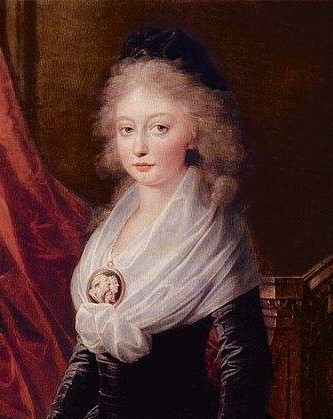
Portrait of Marie Thérèse of France (1778-1851) by Heinrich Fuger 
The sole survivor.

Portrait of Marie Thérèse of France by Heinrich Furger.